

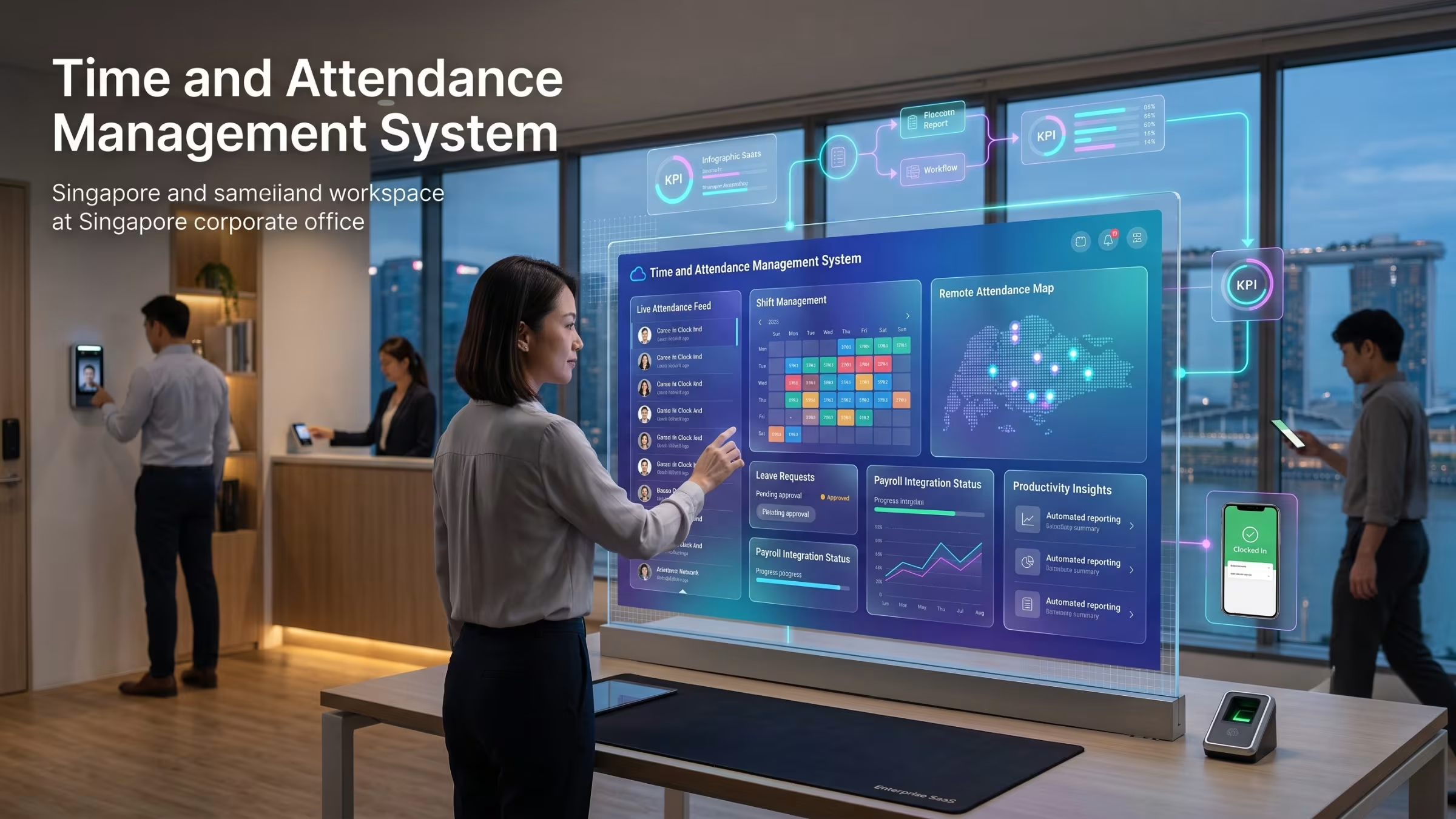
Time and attendance system Singapore has a compliance function that most employers underestimate at the point of purchase. The system is not just tracking who came in when. It is generating the employment records that MOM requires under the Employment Act, the overtime hours that determine whether the 72-hour monthly cap has been breached, the shift patterns that confirm rest day work entitlement, and the attendance data that feeds payroll. Our team has seen Singapore employers choose the cheapest attendance system available and then spend weeks reconstructing attendance records before an MOM inspection because the cheap system could not export the required format. The attendance system is a compliance infrastructure, not a time-saving tool for managers.
Time and Attendance System Singapore
- Singapore employers must maintain employment records, including hours worked for employees covered by Part IV of the Employment Act. This applies to employees earning up to a SGD 2,600 basic salary (Source: MOM).
- Attendance records must be retained for at least 2 years: A system that cannot export historical records or that deletes data after 12 months is non-compliant for MOM purposes.
- Overtime hour tracking is required for Part IV employees: The system must be able to report total overtime hours per employee per month against the 72-hour monthly cap.
- Payroll integration reduces the primary source of payroll errors: Manual transfer of attendance data to payroll is the most common source of overtime calculation errors in Singapore SMEs.
- Three primary capture methods exist: Biometric (fingerprint, face), card/fob, and mobile app. Each has different accuracy, cost, and PDPA implications.
MOM Record-Keeping Requirements for Attendance
For employees covered by Part IV of the Employment Act (earning up to SGD 2,600 basic salary), employers must keep records of:
- Hours worked each day
- Overtime hours worked each day
- Rest days taken
- Public holidays worked
These records must be retained for 2 years and made available to MOM on request.
For employees above Part IV coverage (salary above SGD 2,600 for non-workmen), attendance records are not a strict MOM requirement but are the practical evidence base for any overtime or rest day dispute.
Attendance Capture Methods
Three methods are used in Singapore workplaces to capture attendance:
Biometric capture (fingerprint, face, palm): The most accurate and fraud-resistant method. Cannot be clocked in by a proxy. PDPA consent and data security obligations apply. Cost: SGD 500-2,000 per device. Appropriate for workplaces where buddy punching is a risk or where accurate individual presence confirmation is required.
Card and fob capture: Proximity or smart card-based tap-in and tap-out. Inexpensive and easy to manage. Risk of proxy clocking (one employee cards in for another). Cost: SGD 100-400 per reader. Appropriate for lower-risk environments with managed roster discipline.
Mobile app with GPS or geofencing: Employee checks in via smartphone app within a defined location radius. Appropriate for field-based employees, remote workers, or multi-site workers without fixed workstations. Does not work well for fixed-location, high-volume environments (factories, retail).
For the biometric attendance system in Singapore, the device selection decision is covered in detail, including accuracy metrics (FAR and FRR) and Singapore-specific environmental considerations.
Core System Features for Singapore Compliance
A time and attendance system for Singapore compliance must include:
| Feature | Compliance purpose |
|---|---|
| Individual time-in and time-out capture | MOM daily hours record |
| Overtime calculation engine | Correct 1.5x rate determination; 72-hour cap monitoring |
| Rest day and public holiday flagging | Correct premium pay determination |
| Shift schedule management | Correct hours calculation for rotating shifts |
| 2-year record retention with export | MOM compliance and dispute evidence |
| Leave integration | Absence types correctly categorised (annual leave, sick leave, no-pay leave) |
| Payroll export | Direct feed to the payroll system, eliminating manual data transfer |
The payroll export feature is the most commercially important integration. An attendance system that produces data in a format incompatible with the payroll system creates a manual re-entry step that is the single largest source of payroll errors in Singapore SMEs.
Shift Work and Compressed Schedule Considerations
Singapore employers with shift workers require additional system capabilities:
- Roster publishing at least 48 hours in advance (required for Part IV employees under the Employment Act)
- Shift swap management with approval workflow
- Night shift differential tracking (where applicable by contract)
- Cross-midnight shift handling (clock-in on Day 1, clock-out on Day 2 — must be counted as one shift, not split)
- Compressed work week configuration (e.g., 4-day, 10-hour schedule)
For healthcare, F&B, logistics, and manufacturing employers in Singapore, these shift management features are not optional extras. They are the core of the compliance function.
Frequently Asked Questions
Does a Singapore employer legally need a time and attendance system?
There is no law requiring a specific type of time and attendance system. What is required under the Employment Act is that attendance records for Part IV employees are maintained and retained for 2 years. How those records are captured (paper timesheet, card system, biometric, or mobile) is the employer’s choice. In practice, any system that can produce accurate, exportable, 2-year records satisfies the requirement.
What happens if a Singapore employer cannot produce attendance records during an MOM inspection?
Failure to produce required employment records is an offence under the Employment Act, with a fine of up to SGD 1,000 per offence. MOM may also require the employer to reconstruct records at their own cost. If the records gap relates to an overtime or salary underpayment dispute, the presumption may run against the employer.
How does a time and attendance system handle employees who forget to clock out in Singapore?
Most systems allow HR administrators to manually correct missed clock-out entries with an approval workflow and audit trail. The correction should record the administrator who made the change, the original entry, and the reason for the correction. A consistent pattern of forgotten clock-outs that benefit the employer (e.g., always shorter shifts after manual correction) is a red flag in any MOM investigation.
Can Singapore employers use WhatsApp messages as attendance records?
WhatsApp messages are not a reliable attendance record system. They are not searchable, not structured, and not auditable in the way MOM requires. WhatsApp approvals of leave or overtime are the informal equivalent of verbal approvals: they exist, but they do not constitute the formal employment records the Employment Act requires. An employer who relies on WhatsApp attendance records will struggle significantly in any MOM inspection or ECT claim.
What is the typical cost of a time and attendance system for a Singapore SME?
For a Singapore SME with 20 to 50 employees, a cloud-based time and attendance system with basic biometric or card capture costs SGD 200-500 per month on a subscription basis. Hardware costs (biometric readers or card readers) are a one-time capital cost of SGD 500-2,000 per device. For 50 to 200 employees, enterprise HRMS platforms with integrated attendance management typically cost SGD 15-30 per employee per month.
Conclusion
A time and attendance system in Singapore serves the MOM compliance function first and the operational efficiency function second. The system must capture individual hours accurately, calculate overtime correctly against the 72-hour monthly cap, retain records for at least 2 years, and export data in a format compatible with the payroll system. The attendance system that cannot meet these requirements creates compliance liability every day it operates. For Singapore employers with Part IV employees, accurate attendance records are not optional: they are the evidence base for every payroll compliance and overtime dispute that will ever arise.
Tipsoi’s HR platform includes integrated time and attendance management for Singapore employers with MOM-compliant record retention and payroll integration. Get a quote. Download Tipsoi’s Singapore Attendance System Selection Guide for a feature and compliance checklist.