


Most HR software for SMEs Singapore: once when they pick the cheapest option available, and again two years later when it cannot handle CPF age-bracket calculations or MOM leave rules correctly. Our team works with SMEs across Singapore that have made this exact mistake. The goal of this guide is to help you buy once by knowing what MOM compliance actually requires, which features genuinely matter at 20 to 100 employees, and which add-ons are sold aggressively but used by nobody in your size bracket.
Key Takeaways
- MOM requires itemised payslips for all employees under the Employment Act: HR software must generate these automatically (Source: MOM, https://www.mom.gov.sg/employment-practices/salary/itemised-payslips)
- CPF auto-calculation is the most common source of payroll errors in Singapore SMEs: software that handles it incorrectly exposes you to CPF Board penalties
- Attendance integration matters more than most SMEs realise: manual timesheet imports create errors at the payroll step
- Per-user pricing is the most SME-friendly model: avoid annual seat minimums above your current headcount
- Implementation takes two to four weeks for a 20 to 50-person SME with clean employee data
What HR Features Does a Singapore SME Actually Need?
The honest answer is fewer than most vendors quote. For a 20 to 100-person Singapore business, the non-negotiable features are:
Payroll with CPF auto-calculation: CPF contribution rates change by employee age bracket, and the Ordinary Wage ceiling changes periodically. Software that auto-updates these rates saves you from manual errors and CPF Board late payment penalties (Source: CPF Board, https://www.cpf.gov.sg/employer/employer-obligations/how-much-cpf-contributions-to-pay).
MOM-compliant leave management: Annual leave, sick leave, maternity, paternity, childcare, and NS leave all have specific entitlement rules under the Employment Act. The software must calculate pro-rated leave for mid-year joiners and handle leave encashment on resignation automatically (Source: MOM, https://www.mom.gov.sg/employment-practices/leave).
Itemised payslips: MOM requires payslips to include specific fields: basic pay, allowances, deductions, CPF employer and employee contribution amounts, and net pay. Software must generate these without manual formatting (Source: MOM, https://www.mom.gov.sg/employment-practices/salary/itemised-payslips).
Employee database: A central record for each employee’s personal details, employment terms, work pass information, and document storage (contracts, ICs, passes).
Attendance tracking: Either built-in or integrated with a biometric device. Manual timesheets work for very small teams but create reconciliation errors as headcount grows past 20.
Features you probably do not need yet at SME scale: performance appraisal modules, learning management systems, succession planning tools, and advanced workforce analytics dashboards. These add cost without adding compliance value.
What Does MOM Compliance Require from HR Software?
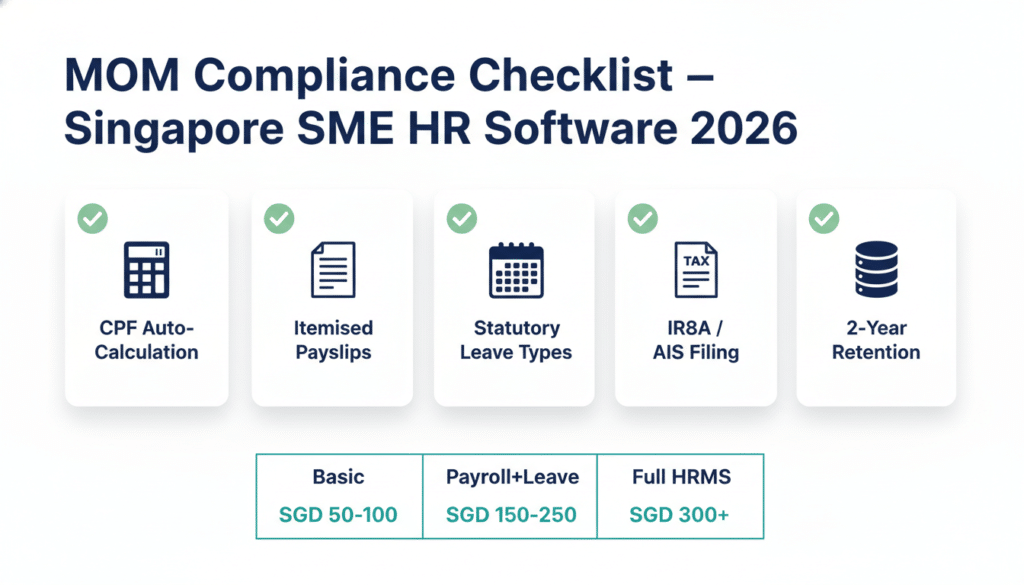
MOM compliance for a Singapore SME covers five key areas that HR software must support:
1. Employment Act leave entitlements: The software must correctly calculate annual leave entitlement by years of service (7 to 14 days under the Act), handle pro-ration for partial years, and track all statutory leave types. Errors here create disputes that can reach the Employment Claims Tribunal.
2. Overtime calculation: Non-PME employees are entitled to 1.5x the hourly basic rate for overtime beyond 44 hours per week under Employment Act Section 38 (Source: MOM, https://www.mom.gov.sg/employment-practices/hours-of-work-overtime-and-rest-days). Software must flag when an employee approaches the threshold and calculate correctly.
3. CPF submission: Software must generate the CPF contribution file in the format accepted by the CPF Board’s e-Submission portal, and auto-update contribution rates when the CPF Board announces changes (Source: CPF Board, https://www.cpf.gov.sg).
4. IR8A filing: For annual tax filing, the software must produce IR8A forms and support submission through the IRAS Auto-Inclusion Scheme (AIS) (Source: IRAS, https://www.iras.gov.sg/taxes/individual-income-tax/employers/auto-inclusion-scheme-(ais)-for-employment-income/join-the-auto-inclusion-scheme-(ais)-for-employment-income).
5. Record retention: Payroll and employment records must be kept for at least two years under the Employment Act (Source: MOM, https://www.mom.gov.sg/employment-practices/employment-records).
“The cheapest HR software in Singapore costs you the most in MOM penalties. A SGD 10 per user per month system that cannot calculate CPF correctly will cost you more in a single CPF Board late penalty than a full year’s subscription to a compliant system.”
How Much Does HR Software Cost for a Singapore SME?
Most Singapore cloud HR software for SMEs is priced per employee per month. Expect:
| Plan Type | Typical Price (SGD) | What’s Included |
|---|---|---|
| Basic payroll only | SGD 5-10 / employee/month | Payslips, CPF, IR8A |
| Payroll + leave | SGD 10-18 / employee/month | Above + leave management |
| Full HRMS | SGD 15-30 / employee/month | Above + attendance, HR database, ESS portal |
| With biometric device | Add SGD 200-800 per device | Hardware + integration |
Watch for hidden costs: implementation fees (SGD 500 to 3,000 for SMEs), data migration fees if moving from a legacy system, and per-module add-ons for features advertised as part of the base plan.
Our recommendation for a 30-person Singapore SME: budget SGD 400 to 600 per month for a full HRMS including payroll, leave, and attendance. This is the realistic all-in cost once you account for the features MOM compliance actually requires. Anything significantly below this usually means something is missing from the compliance stack.
What Should a Singapore SME Ask Before Signing an HR Software Contract?
Five questions that filter out non-compliant or mismatched vendors fast:
1. Does it auto-calculate CPF for all age brackets, including employees above 55? CPF contribution rates differ by age bracket (below 55, 55-60, 60-65, above 65). Many budget systems only handle the standard under-55 rate correctly.
2. Does it support all MOM statutory leave types including NS leave and childcare leave? Some systems only handle annual and sick leave. NS makeup pay and childcare leave require specific configuration.
3. Is the AIS IR8A submission built in, or is it an add-on? Some vendors charge extra for IRAS AIS integration.
4. Can attendance data feed payroll without a manual CSV export? API integration between attendance and payroll is the difference between a two-minute payroll run and a two-hour reconciliation exercise.
5. What is the data migration process if you leave? Vendor lock-in is real. Ensure you can export all payroll history and employee records in a standard format.
How Long Does HR Software Implementation Take for a Singapore SME?
For a 20 to 50-person SME with clean employee data, implementation typically runs two to four weeks:
- Week 1: Account setup, employee data import, payroll configuration (salary components, CPF settings, leave entitlements)
- Week 2: Test payroll run: process one month’s payroll in parallel with your existing system and compare results
- Week 3: Biometric device installation and attendance configuration (if applicable), employee self-service portal activation
- Week 4: Go-live: first live payroll run, first live leave approvals through the new system
The biggest delay in most Singapore SME implementations is not the software: it is getting clean, complete employee data ready for import. Inconsistent leave balances, missing CPF account numbers, and outdated employment terms slow every implementation down. Prepare your data first.
Frequently Asked Questions
Is HR software mandatory for Singapore SMEs?
HR software is not mandated by law, but the obligations it fulfils – accurate payslips, correct CPF contributions, proper leave records, IR8A filing – are legally required. Doing these manually becomes impractical above 10 employees and error-prone above 20. MOM audits and CPF Board reviews check outputs, not how you produced them.
What is the minimum number of employees to justify HR software?
There is no universal number, but most Singapore SMEs find that five to 10 employees is the practical threshold. Below five, a spreadsheet can work. Above 10, the overtime, leave, and CPF rules become complex enough that manual tracking creates consistent errors.
Can HR software handle both local and foreign employee payroll in Singapore?
Yes, provided the software supports CPF for local employees and correct handling of work pass holders who are CPF-exempt. Foreign employees on Employment Pass, S Pass, and Work Permits have different CPF obligations: verify the software handles all three correctly before signing.
Does HR software integrate with accounting software like Xero or QuickBooks?
Most Singapore HR software platforms offer Xero and QuickBooks integration. Confirm whether journal entries are pushed automatically after each payroll run or whether manual export is required. Automatic push eliminates a reconciliation step that many SME finance teams spend hours on each month.
Can I manage attendance with a mobile app instead of a biometric device?
Yes. Mobile attendance apps use GPS geofencing or IP restriction to verify that the employee clocked in from an approved location. This works well for remote and field teams. For office-based staff, a biometric device is more reliable because it cannot be spoofed by VPN or location-sharing apps. See our employee attendance tracking Singapore guide for a full comparison.
What happens if I need to switch HR software later?
Data portability is a real risk. Before signing, ask for a sample data export in CSV or Excel format covering payroll history, leave balances, and employee records. If the vendor cannot provide this, build exit costs into your decision.
Conclusion
Singapore SMEs do not need enterprise HR software: they need software that is correctly configured for CPF, MOM leave rules, and IR8A from day one. The market is full of affordable options, but affordable and compliant are not always the same thing. Ask hard questions about CPF age-bracket support and statutory leave types before you commit.
Tipsoi’s HR software is built for Singapore compliance out of the box: CPF auto-calculation, MOM-compliant leave, itemised payslips, and biometric attendance integration in one stack. See how it fits a team your size at tipsoi.ai.


