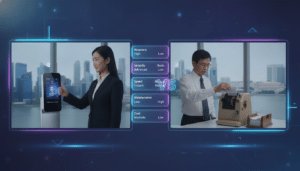


The punch card has survived in Singapore longer than it should have. We have visited worksites where supervisors still collect physical cards at the end of the shift and key the hours manually into a spreadsheet. The error rate in that process is not low: missed punches, illegible cards, and outright buddy punching (one worker clocking in for an absent colleague) are routine. Biometric time clock Singapore eliminates these problems by tying attendance records to a physical characteristic that cannot be lent or forged. This guide covers how they work, what they cost, and what Singapore employers must know before deploying them.
Key Takeaways
- Buddy punching costs Singapore employers an estimated 2-3% of gross payroll: biometric time clocks eliminate it by requiring physical presence for clock-in
- Three biometric technologies dominate the Singapore market: fingerprint, face recognition, and palm vein: each with different accuracy, cost, and environmental suitability
- MOM requires accurate attendance records for overtime calculation and Employment Claims Tribunal disputes: a biometric record is far stronger evidence than a handwritten card
- PDPA compliance is mandatory: biometric data is classified as sensitive personal data and requires a written data protection policy and employee consent before collection
- Payroll integration is the key ROI driver: a time clock that exports CSV only still requires manual steps; one with direct payroll API integration eliminates them
What Is a Biometric Time Clock?
A biometric time clock is an attendance terminal that identifies employees using a physical characteristic (fingerprint, face, palm vein, or iris) instead of a card, PIN, or paper. The terminal records a timestamp when the employee clocks in or out, links it to the employee’s identity, and transmits the record to the HR or attendance system.
The core advantage over punch cards and PIN-based systems is non-transferability. A fingerprint cannot be lent to a colleague. A face cannot be borrowed. This eliminates buddy punching entirely, which is the most common form of time theft in Singapore shift-based operations.
Technology comparison:
| Technology | FAR (False Accept Rate) | Environment | Cost Range (SGD) |
|---|---|---|---|
| Fingerprint (optical) | 0.001% | Indoor, dry | 200-600 |
| Fingerprint (capacitive) | 0.0001% | Indoor, moderate humidity | 400-900 |
| Face recognition | 0.001-0.01% | Indoor/outdoor with cover | 600-2,000 |
| Palm vein | 0.00008% | Indoor, any hand condition | 1,500-4,000 |
| Iris | 0.0001% | Indoor, controlled lighting | 2,000-5,000 |
For most Singapore manufacturing, F&B, and logistics operations, capacitive fingerprint or face recognition covers 95% of use cases at a cost that is recoverable within one payroll cycle of buddy-punching elimination.
Why Are Punch Cards Still Used in Singapore and Why Should They Be Replaced?
Punch cards persist in Singapore for two reasons: initial cost resistance and inertia. The card punching machine costs under SGD 200. Most biometric terminals cost SGD 400 to 2,000. The upfront difference feels significant to small operators.
The hidden cost calculation changes the picture. A construction site with 40 workers, where 10% are buddy-punching at least two shifts per month, loses roughly 8 paid shifts per month to phantom attendance. At SGD 100 per shift, that is SGD 800 per month, or SGD 9,600 per year: far more than the cost of two biometric terminals.
Beyond cost, punch cards create a legal exposure problem. If an employee files an overtime dispute at the Employment Claims Tribunal, the employer must produce attendance records proving hours worked (Source: MOM, https://www.mom.gov.sg/employment-practices/hours-of-work-overtime-and-rest-days). A handwritten punch card that has been manually re-keyed into a spreadsheet is weak evidence. A timestamped biometric record linked to a specific fingerprint or face scan is far stronger.
How Does a Biometric Time Clock Integrate with Singapore Payroll?
Integration quality determines most of the ROI from a biometric time clock. A terminal that exports a CSV file daily and requires manual import into payroll is better than punch cards, but still depends on a human step.
Three levels of integration available in Singapore:
Level 1: CSV Export Only: Terminal stores records locally, exports a flat file on a schedule or on demand. Payroll admin imports the file manually. Risk of missed imports, format errors, and data gaps if the terminal is offline.
Level 2: Software-to-Software: The biometric terminal vendor provides attendance management software that consolidates records and exports to the HR system via a scheduled sync. Reduces manual steps but adds a middleware layer that can fail.
Level 3: Direct API Integration: The biometric terminal or its software exposes an API that the HR/payroll system calls directly. Records flow in real-time. Offline records are queued and synced automatically. No human import step. This is the standard that enterprise Singapore deployments should require.
For overtime to be calculated correctly under MOM’s Employment Act Section 38 overtime rules, the system must know both the contracted hours and the actual hours worked per employee (Source: MOM, https://www.mom.gov.sg/employment-practices/hours-of-work-overtime-and-rest-days). This requires the biometric record to be linked to the correct employee record and shift schedule in the HR system, not just a standalone timestamp file.
What Are the PDPA Requirements for Biometric Data in Singapore?
Biometric data: fingerprints, face geometry, and palm vein patterns are classified as sensitive personal data under the Personal Data Protection Act (PDPA). Collecting it without proper consent and policies is a breach that can result in financial penalties from the Personal Data Protection Commission (PDPC) (Source: PDPC, https://www.pdpc.gov.sg/Overview-of-PDPA/The-Legislation/Personal-Data-Protection-Act).
What Singapore employers must do before deploying biometric time clocks:
- Written consent: Each employee must give written consent for biometric data collection. The consent form must explain what data is collected, how it is stored, who has access, and how long it is retained.
- Data minimization: Only collect what is needed. For attendance purposes, a fingerprint template (a mathematical representation, not the actual fingerprint image) is sufficient. Storing raw fingerprint images is unnecessary and increases risk.
- Storage security: Biometric templates must be stored with encryption. If stored on the terminal itself, the terminal must have tamper protection. If stored centrally, access must be logged and restricted.
- Retention limits: Biometric data must be deleted within a reasonable time after the employee leaves. Most Singapore employers set a 30-day retention period post-departure. Retaining data indefinitely is a PDPA breach.
- Data breach protocol: If the terminal is stolen or the database is compromised, employers must notify PDPC within 3 business days if the breach is likely to cause significant harm (Source: PDPC, https://www.pdpc.gov.sg/Overview-of-PDPA/The-Legislation/Personal-Data-Protection-Act).
“Fingerprint and face data are not like a password: you cannot change them if it is compromised. Singapore employers who treat biometric storage as a minor IT matter rather than a data protection obligation are taking on significant regulatory risk.”
What Should Singapore Employers Check Before Buying a Biometric Time Clock?
Five practical checks before purchasing:
1. FAR and FRR specifications: False Accept Rate (FAR) is the rate at which the wrong person is accepted. False Reject Rate (FRR) is the rate at which the right person is rejected. Ask for both figures with the specific sensor model, not generic marketing claims. Target FAR below 0.001% for payroll-linked systems.
2. Offline capability: Ask how many records the terminal stores locally when the network is down. A terminal with 50,000-record local storage will not lose data during a network outage. A terminal with no local storage loses data immediately.
3. Integration compatibility: Ask which HR and payroll systems the terminal integrates with natively, and whether the integration is API-based or CSV-based. Get this in writing.
4. Humidity and environment tolerance: Fingerprint terminals perform differently in humid Singapore conditions vs. air-conditioned offices. Optical sensors struggle with wet or dirty fingers common in F&B and construction. Capacitive or multispectral sensors handle these better.
5. PDPA compliance features: Ask whether the terminal stores raw fingerprint images or mathematical templates only. Templates are PDPA-safer than images. Ask whether template data is encrypted at rest.
Frequently Asked Questions
Are biometric time clocks legally required in Singapore?
No. Singapore’s MOM does not mandate a specific attendance recording technology. Employers are required to maintain accurate records of hours worked for overtime and Employment Act compliance, but the format is not prescribed. Biometric systems are chosen because they produce more reliable and dispute-resistant records than manual alternatives.
Can employees refuse to use a biometric time clock?
Employees can raise concerns about biometric data collection. Under PDPA, consent must be obtained before collecting biometric data. If an employee withholds consent, the employer must provide an alternative attendance recording method. Terminating an employee solely for refusing biometric data collection creates legal risk.
How long does it take to enroll all employees in a biometric system?
Enrollment time is roughly 30 seconds per employee per biometric type. Fingerprint enrollment requires scanning each finger 3-5 times. Face enrollment requires the employee to look at the camera for a few seconds. For a 100-person workforce, full enrollment takes under one hour with two terminals running simultaneously.
What happens if a worker’s fingerprint cannot be read, for example, due to manual work damage?
Workers in manual trades (construction, landscaping, food prep) frequently have worn or damaged fingerprints that fingerprint sensors cannot read reliably. The solution is to enroll a backup biometric: typically, face recognition, or to use a secondary verification method, such as a proximity card, for the specific employee. Most modern biometric terminals support dual-mode enrollment.
Do biometric time clocks work for shift workers in Singapore?
Yes. Most biometric time clock systems support shift scheduling, meaning the system knows which employees are expected at which times and can flag no-shows, late arrivals, or early departures automatically. This is particularly useful for Singapore employers in manufacturing, healthcare, and hospitality, where shift scheduling is complex.
What is the typical total cost of ownership for a biometric time clock system in Singapore?
A single-terminal deployment for 50 employees typically costs SGD 800-2,500 for hardware, SGD 500-2,000 for software and initial setup, and SGD 200-600 per year for maintenance and software updates. For a 5-site deployment with centralized HR integration, budget SGD 8,000-20,000 total first-year cost, with annual costs of SGD 2,000-5,000 thereafter.
Conclusion
The punch card is a liability. It produces records that cannot be verified, enables fraud that comes directly out of payroll, and generates evidence that loses at the Employment Claims Tribunal. Biometric time clocks have come down in cost to the point where the break-even on buddy-punching prevention alone is measured in weeks, not years. The remaining decision is technology type, integration depth, and PDPA compliance: not whether to make the switch.
Tipsoi’s biometric attendance system integrates fingerprint and face recognition hardware with Singapore-compliant payroll, CPF auto-calculation, and MOM attendance record requirements in one connected platform. See how it works for your site at tipsoi.ai.