


“MOM-compliant” is one of the most overused labels in MOM-compliant HR software Singapore marketing. Every vendor claims it. Few explain what it actually covers. Our team has reviewed dozens of Singapore HR platforms and found that most handle payslips and CPF correctly but fail on less-visible requirements like Occupational Employment Dataset (OED) reporting, Flexible Work Arrangement (FWA) documentation, and Progressive Wage Model (PWM) tracking. This guide breaks down what MOM compliance genuinely requires, how to verify it before signing, and where most software falls short.
Key Takeaways
- MOM compliance covers at least seven distinct obligations: payslips, CPF, leave, overtime, OED reporting, FWA documentation, and work pass tracking
- Itemised payslips are legally required for all employees under the Employment Act and must include specific fields (Source: MOM, https://www.mom.gov.sg/employment-practices/salary/itemised-payslips)
- OED reporting is mandatory for all registered businesses: employers must submit occupational and employment data for every employee to MOM annually (Source: MOM, https://stats.mom.gov.sg/Pages/oed-faq.aspx)
- FWA documentation requirements took effect in 2024: HR software must support formal FWA request and response logging under Tripartite Guidelines (Source: MOM, https://www.tal.sg/tafep/getting-started/progressive/tripartite-standards#fwa)
- PWM compliance requires salary tracking by occupation in covered sectors: software must flag when an employee’s pay falls below the applicable PWM floor
What Does MOM-Compliant HR Software Singapore Actually Require?
MOM compliance is not a single certification or checkbox. It is a combination of Employment Act obligations, CPF Board requirements, IRAS filing rules, and MOM-specific data reporting mandates. Software that handles only payslips and CPF passes a basic test but fails a thorough audit.
The seven layers of MOM compliance every Singapore employer needs:
- Itemised payslips with mandatory fields
- CPF auto-calculation and e-Submission
- Employment Act leave entitlements and tracking
- Overtime calculation under Section 38
- OED (Occupational Employment Dataset) reporting
- FWA formal request and response documentation
- Work pass expiry tracking and MOM portal integration
A vendor that covers all seven is genuinely MOM-compliant. A vendor that covers only the first four is compliant for basic operations but creates risk in audit situations.
What Must an Itemised Payslip Include Under MOM Rules?
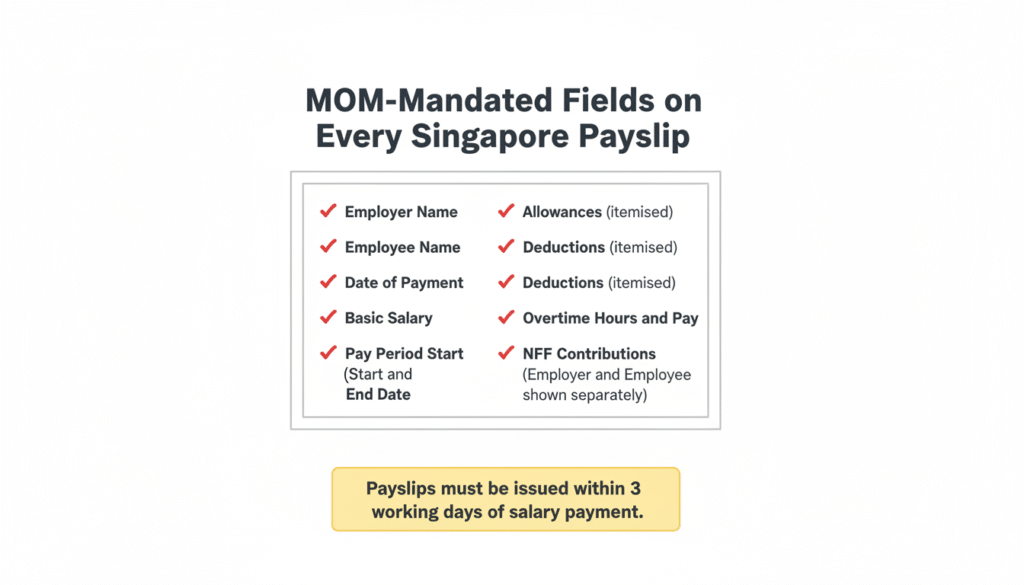
MOM mandates that every payslip must include specific fields. Missing even one field makes the payslip non-compliant, which is a breach of the Employment Act (Source: MOM, https://www.mom.gov.sg/employment-practices/salary/itemised-payslips).
Required fields on every Singapore payslip:
| Field | Requirement |
|---|---|
| Employer name | Full registered name |
| Employee name | As per employment contract |
| Date of payment | Actual payment date |
| Basic salary | Gross before deductions |
| Start and end date of pay period | Both dates required |
| Allowances | Itemised per type |
| Deductions | Itemised per type |
| Overtime hours and pay | If applicable |
| Net salary paid | After all deductions |
| CPF contributions | Employer and employee amounts shown separately |
HR software must generate payslips containing all these fields automatically. Payslips must be issued within three working days of salary payment, or within seven days if payment is by cheque or GIRO.
“Most Singapore payslip disputes at the Employment Claims Tribunal happen because the employer cannot produce a payslip that shows itemised allowances and deductions separately. The law is clear on this: software that bundles everything into ‘gross pay’ creates a compliance gap.”
What Does CPF Compliance Require from HR Software?
CPF compliance has three components that HR software must handle correctly (Source: CPF Board, https://www.cpf.gov.sg/employer/employer-obligations/how-much-cpf-contributions-to-pay):
Contribution rate accuracy: Rates differ by employee age bracket (below 55, 55-60, 60-65, 65-70, above 70) and citizenship (Singapore Citizen vs Permanent Resident with different rates in years 1, 2, and 3). Software must store and auto-apply the correct rate for each employee.
Ordinary Wage ceiling: Only the first SGD 6,800 per month (as of 2026) of ordinary wages is subject to CPF contributions. Software must correctly cap contributions at this ceiling and handle Additional Wage separately (Source: CPF Board, https://www.mom.gov.sg/employment-practices/central-provident-fund/cpf-contributions).
e-Submission format: CPF contributions must be submitted monthly via CPF Board’s e-Submit@web portal. HR software must generate the submission file in the exact format required, and auto-update when CPF Board changes rate tables.
What Are the OED Reporting Requirements?
All registered Singapore businesses must submit Occupational Employment Dataset (OED) data to MOM. This covers every employee: Citizens, Permanent Residents, and foreigners (Source: MOM, https://stats.mom.gov.sg/Pages/oed-faq.aspx).
OED requires reporting of: employee occupation code, employment type (full-time, part-time, contract), monthly gross wage, and work pass type for foreign employees.
Most Singapore SMEs are unaware of OED because it is submitted through the Corppass portal and many HR software vendors do not surface it prominently. Failure to submit is a breach of the Statistics Act. HR software should either generate the OED submission file directly or provide an export in the required format.
How Must HR Software Handle the FWA Documentation Requirement?
Tripartite Guidelines on Flexible Work Arrangements took effect in December 2024. Under these guidelines, employees have the right to formally request FWA, and employers must respond formally with reasons if declining (Source: MOM, https://www.tal.sg/tafep/getting-started/progressive/tripartite-standards#fwa).
What HR software must support:
- A structured FWA request form (or workflow) that employees can submit through the system
- A response workflow for managers with outcome logging (approved/declined / counter-proposed)
- A timestamped record of both request and response, retained for at least one year
Software that only tracks leave and attendance does not cover this. The FWA requirement is a separate documentation obligation that sits in HR workflow, not payroll.
How Does PWM Compliance Work in HR Software?
The Progressive Wage Model (PWM) sets minimum wage floors by occupation in covered sectors: cleaning, security, landscape, retail, food services, lift maintenance, and waste management (Source: MOM, https://www.mom.gov.sg/employment-practices/progressive-wage-model).
HR software for Singapore businesses in these sectors must:
- Store each employee’s occupation code
- Apply the applicable PWM floor for that occupation and year
- Flag any employee whose basic salary falls below the PWM floor before payroll is processed
- Generate a PWM compliance report for MOM audit purposes
PWM floors are updated annually. Software that does not auto-update these values will silently fail compliance each time MOM announces a revision.
What Should You Verify Before Calling an HR System MOM-Compliant?
Five specific checks that go beyond vendor marketing claims:
1. CPF rate table update process: Ask when the software last updated its CPF rate table and who initiates the update. Auto-update on CPF Board announcement is the right answer. Manual update requiring IT involvement is a risk.
2. OED export capability: Ask for a sample OED export file. If the vendor does not know what OED is, walk away.
3. FWA workflow: Ask to see the FWA request and response workflow. If the vendor says “employees can email their manager,” that is not a documented workflow and does not meet the Tripartite Guideline requirement.
4. PWM occupation tracking: Ask whether the system can flag an employee below the PWM floor before payroll runs. This requires per-employee occupation coding, not just a salary field.
5. Payslip field audit: Ask for a sample payslip PDF and check it against the MOM mandatory field list. Missing fields are an immediate red flag.
Frequently Asked Questions
Is there an official MOM-approved list of HR software in Singapore?
MOM does not maintain a formal approved software list. The term “MOM-approved” used by some vendors refers to their own assessment of compliance, not a government certification. Verify compliance by checking specific features against MOM requirements yourself.
What happens if my payslips are non-compliant with MOM requirements?
Failing to issue compliant itemised payslips is a breach of the Employment Act. First-time offenders typically receive a warning from MOM. Repeat offences can result in fines. In Employment Claims Tribunal disputes, non-compliant payslips weaken your position significantly regardless of whether the underlying pay was correct.
Does HR software need to handle the MOM OED submission directly?
Not necessarily. OED data can be submitted manually through Corppass if your HR software does not automate it. However, manual submission requires pulling data from multiple sources, which is error-prone. Software that exports a pre-formatted OED file saves significant time during the submission period.
What is the Progressive Wage Model and which sectors does it cover?
The Progressive Wage Model (PWM) sets legally binding minimum wage floors by occupation within specific sectors: cleaning, security, landscape, retail, food services, lift maintenance, and waste management. It is different from the general minimum wage concept. PWM floors are updated annually by MOM (Source: MOM, https://www.mom.gov.sg/employment-practices/progressive-wage-model).
Can HR software track work pass expiry dates automatically?
Yes. Most mid-range and enterprise Singapore HR software includes a work pass expiry dashboard that flags Employment Pass, S Pass, and Work Permit expiries within a configurable lead time (typically 60 to 90 days). This is especially important for companies with large foreign worker populations.
How does MOM’s FWA requirement differ from a standard leave policy?
FWA covers flexible working arrangements: changes to work hours, work location, or work schedule: not leave. An employee requesting a four-day work week or remote working is making an FWA request, not a leave request. The Tripartite Guidelines require this to be handled through a formal documented process separate from the leave system.
Conclusion
MOM compliance is more than payslips and CPF. Singapore employers who treat it as a checklist of two items will find gaps when OED submission deadlines approach, when a PWM audit is triggered, or when an FWA-related dispute reaches the Tripartite Alliance. Choose HR software that covers all seven compliance layers, and test them before signing, not after.
Tipsoi’s HR software is built for Singapore compliance from the ground up, covering CPF auto-calculation, MOM-compliant payslips, leave entitlements, and payroll integration. See how it fits your compliance requirements at tipsoi.ai.