


Here is the maths I run with UAE finance leads. A 60-person company with an AED 300,000 payroll has one fixed date each month. By then, at least AED 255,000 must reach workers’ accounts. Miss it, and the warnings start within two days. The Wage Protection System (WPS) is how the UAE checks that date. This WPS UAE guide covers who must use it, how to register, the salary file and what late payroll costs.
Key takeaways
- Under WPS UAE rules, every establishment registered with MOHRE pays wages through an agent authorised by the Central Bank.
- Since 1 June 2026, wages for the previous month are due on the first day of each month.
- At least 85% of total wages must arrive on time for a company to count as compliant.
- Work permits are suspended from day 5, and repeat offenders face fines from day 11.
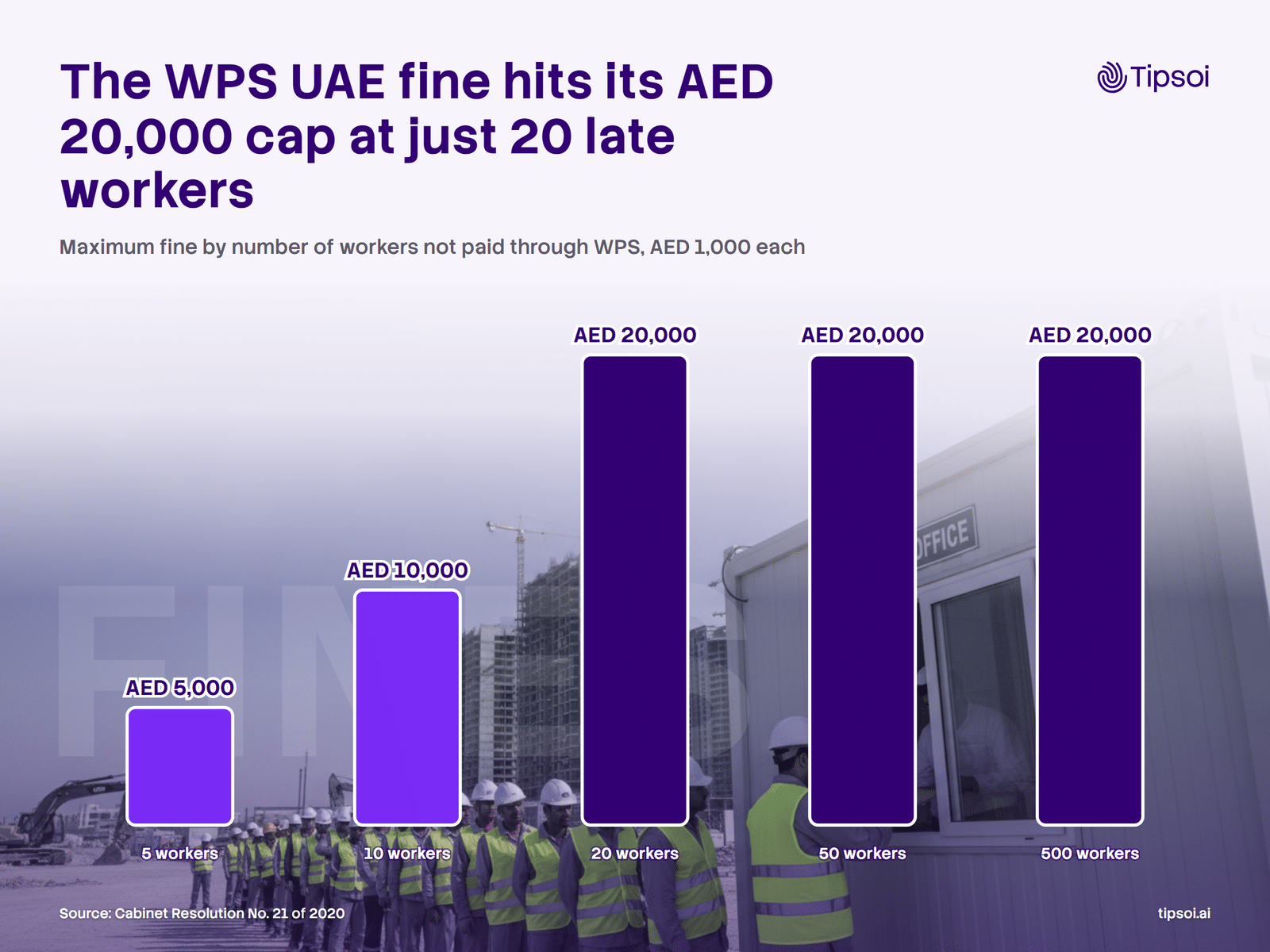
- The fine is AED 1,000 per worker up to AED 20,000, so 20 late workers already hit the cap.
What WPS is
WPS is the UAE’s electronic salary system for the private sector. Employers send wages through an approved agent, such as a bank or exchange house. The Ministry of Human Resources and Emiratisation (MOHRE) then monitors whether wages arrive on time. For a business, that means late salaries are flagged by the system itself.
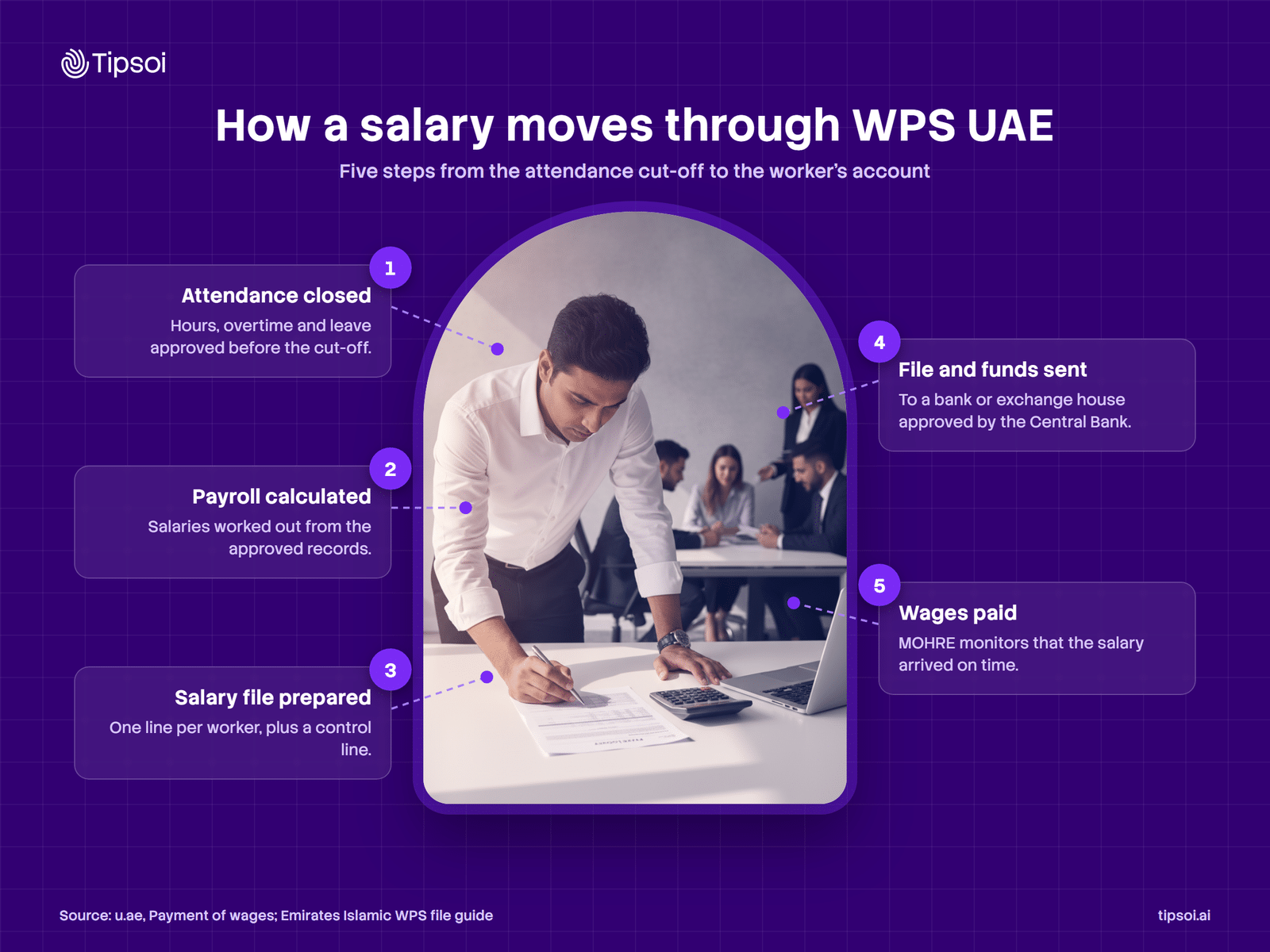
The scale is large. In June 2026, Gulf News reported MOHRE figures showing WPS covers around 99% of private-sector workers. Monthly transfers top Dh37 billion, through more than 90 banks and exchange houses.
Who must use it
The UAE government portal’s page on Resolution No. 340 of 2026 says all establishments registered with MOHRE must pay through WPS. It also lists exceptions. These include seafarers on vessels, workers on unpaid leave, and workers on mission permits of three months or less. Some employers are excluded as well, such as banks, houses of worship, and UAE nationals who own fishing boats or taxis.
How to register
WPS UAE registration is mostly paperwork with your chosen agent. Your company already has a MOHRE establishment number, and the agent links your account to it. After that, each month you send the salary file and the funds, and the agent pays your staff. So don’t leave the account until the week of your first payroll.
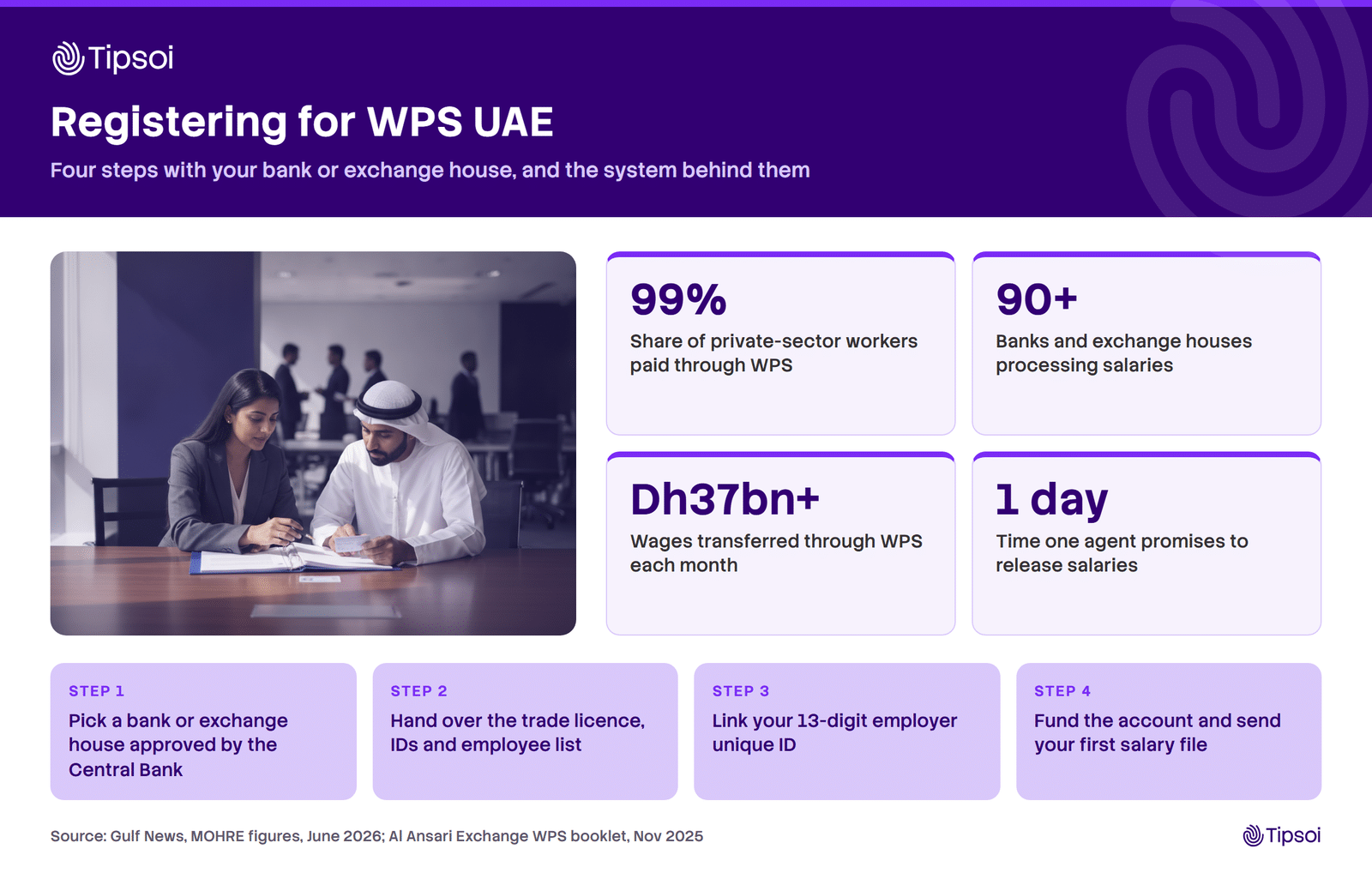
- Pick an agent. Use your bank or an exchange house approved by the Central Bank.
- Prepare documents. Al Ansari Exchange’s November 2025 WPS booklet lists a trade licence, company documents, owner and signatory IDs, and the employee list.
- Link your establishment number. Banks call it the 13-digit employer unique ID.
- Sign and fund. Agree the charges and how you will send salary funds each month.
- Send your first file. From then on, the routine is file plus funds, then payment.
What the salary file holds
The Salary Information File (SIF) is what your agent uses to pay each worker. Emirates Islamic’s WPS file guide explains that each file covers one employer. It holds one record per worker, an extra line for variable pay when needed, and a control line at the end.
| Line | What it holds |
|---|---|
| Employee Detail Record, one per worker | Person ID, agent code, account, pay dates, days paid, fixed and variable pay, leave days. |
| Employee Variable Pay, only when needed | The variable pay amounts for that worker. |
| Salary Control Record, the last line | Employer ID, bank code, file date, salary month, worker count, total salary, currency. |
Once the agent has the file and the money, it’s quick. For example, the Al Ansari agreement promises to release salaries within one working day. Still, timing varies by agent, so a file sent the day before the deadline cuts it close.
Deadlines and fines
The WPS UAE deadline is now fixed, and the penalties are automatic. Wages for the previous month are due on the first day of each month. However, a company that pays at least 85% of total wages on time counts as compliant. From the second day, warnings start, and the steps below follow on set days.

Three reports sum up what changed this year.
- Khaleej Times reported in May 2026 that the old 15-day grace period is gone.
- Morgan Lewis noted in May 2026 that the threshold rose from 80% to 85%.
- MOHRE said in June 2026 that enforcement would start on 1 July, with June salaries.
| Day after due date | What happens |
|---|---|
| Due date and day 2 | Monitoring, then notices to pay. |
| Day 5 | New work permits suspended. |
| Day 11 | Repeat within six months: fine and Third Category. |
| Day 16 | 25 or more workers: labour dispute registered. |
| Day 21 | An order to pay, asset attachment and a travel ban on the person in charge. |
The fine comes from Cabinet Resolution No. 21 of 2020. For wages not paid through WPS, it sets AED 1,000 per worker, up to AED 20,000. For the full story, see our page on the 2026 UAE wage protection system updates.
The cost of late payroll
The fine on late WPS UAE payments caps out fast. At AED 1,000 per worker, it hits AED 20,000 with just 20 late workers. So a 50-person firm and a 500-person firm face the same maximum. However, the bigger costs sit around it. You lose new work permits from day 5, and larger firms face a labour dispute from day 16.
The 85% rule needs the same care. Take a company with an AED 400,000 monthly payroll. It must move at least AED 340,000 by the first of the month. Even so, every worker is owed their full wage, so the other AED 60,000 cannot simply wait.
A payroll calendar that works backwards
Because the agent needs the file and the funds first, I tell finance teams to plan backwards from the due date.
- Seven working days before month end: close attendance and flag missing punches.
- Five working days before: approve overtime and leave.
- Three working days before: calculate payroll and check payslips.
- Two working days before: fund the agent account and send the file.
- Last working day: confirm the agent released salaries.
Most late payrolls I see start with late attendance data. At Tipsoi, our part is the first three steps. The Absent Summary and Late Report show lost hours, and the Overtime Report shows overtime worked next to overtime approved. Payroll is then calculated from those approved records, and your agent handles the transfer as usual. Our time attendance software for UAE teams shows how.
Common questions
What is WPS in the UAE?
WPS is the Wage Protection System, the electronic channel private employers use to pay salaries through an authorised bank or exchange house. It lets MOHRE check that wages arrive on time, so late salaries are flagged automatically.
Is WPS mandatory in the UAE?
Yes, for establishments registered with MOHRE. There are some exceptions, such as seafarers, workers on unpaid leave or short mission permits, and certain employers like banks and houses of worship.
How do I register for WPS?
Choose an authorised bank or exchange house and give them your trade licence, company documents, owner IDs and employee list. Then link your MOHRE establishment number, fund the account and send your first salary file.
How long does a WPS salary take?
It depends on your agent. For example, one exchange house promises to release salaries within one working day of getting the file and the funds. So don’t wait until the day before the due date.
How can workers report unpaid salaries?
Workers can complain through the MOHRE website, the MOHRE app or the labour hotline on 600590000, as Khaleej Times listed in 2026. Employers should keep each agent payment confirmation.
What happens if salaries are late?
Warnings start on day 2, and new work permits stop from day 5. Repeat offenders are fined AED 1,000 per worker, up to AED 20,000, from day 11. Further steps follow from day 16, depending on company size.
Next steps
You can protect this month’s payroll with three moves.
- Check that your WPS UAE agent agreement and account are active.
- Put the backwards payroll calendar into your finance diary.
- Move your attendance cut-off earlier if timesheets arrive on the last day.
If payroll keeps slipping because site and shift hours arrive late, a short call about closing attendance on time is the quickest fix.
Reviewed for UAE labour law accuracy by Aneesh Michael. Last verified September 2026.