


Before any probation review, I ask the manager to write down what they really know about the person. Then we look at what the records show. Too often, the two lists don’t match. Performance management systems exist to close that gap. A performance management system is the process a company uses to set goals, track progress and review each person fairly. Often, software holds the record. In the UAE, it also has to fit the probation and notice rules in Federal Decree-Law No. 33 of 2021. This guide covers what performance management systems are and the main types. It also shows how attendance data makes a review fairer, and which UAE rules shape your review calendar.
Key takeaways
- Performance management systems follow a yearly cycle of five stages: planning, monitoring, developing, rating and rewarding.
- UAE probation can last up to six months. An employer who ends it must give 14 days’ written notice, so hold the first formal review early.
- Attendance, lateness, working-hour and overtime records give performance management systems hard proof, so a manager’s memory carries less weight.
- UAE law does not require a formal review before a dismissal. Even so, written reasons protect you if someone challenges the decision.
- Private companies with 50 or more employees have yearly Emiratisation targets, so keep a clear development record for Emirati staff.
What it is
Performance management systems are the steps a company uses to set goals, track progress, give feedback and review each person’s work. Often, software keeps the record. Instead of one end-of-year form, they build a record all year. That record makes a review fairer. It also protects both sides when a decision is questioned.
The five stages
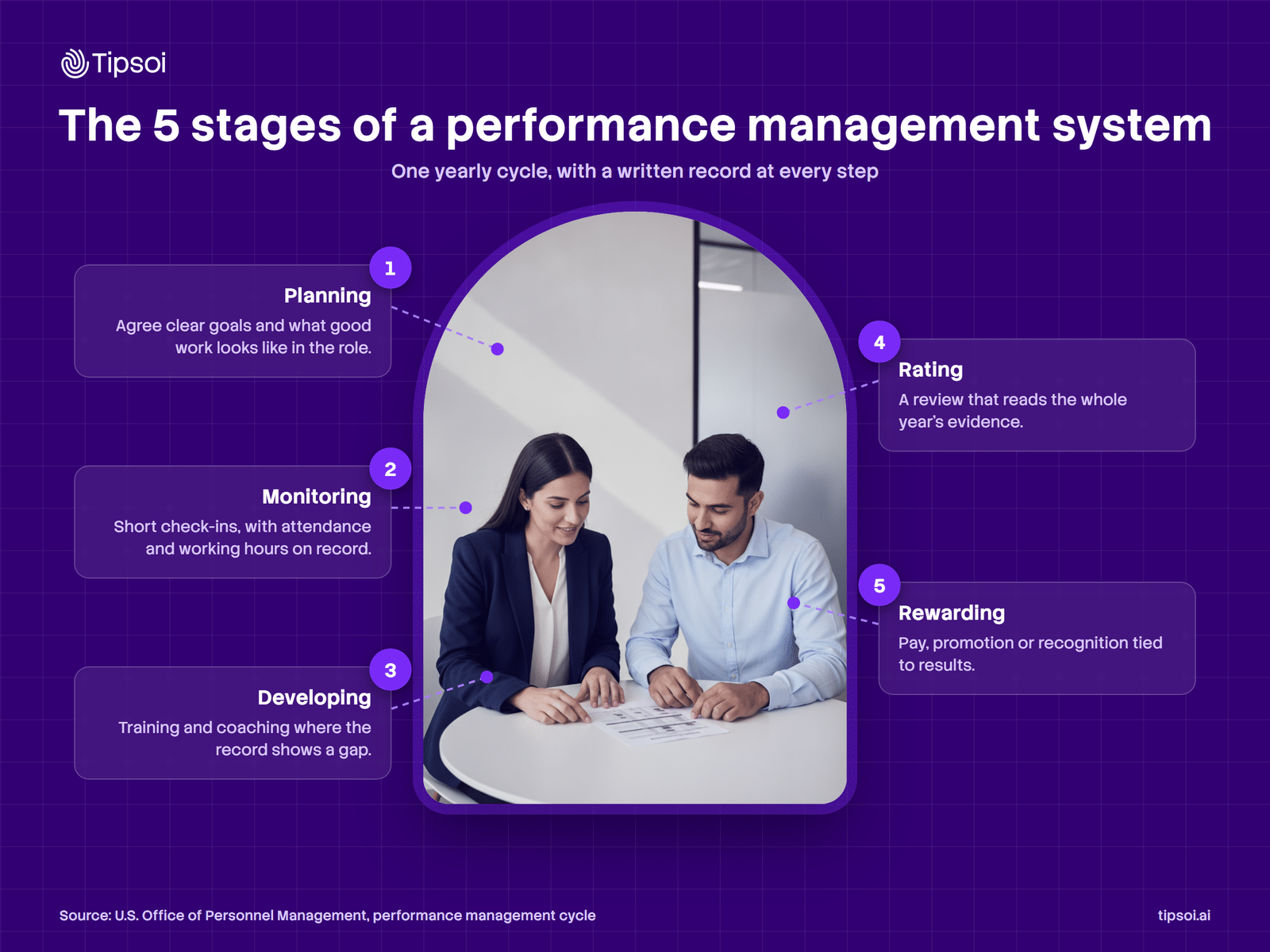
The U.S. Office of Personnel Management describes performance management as a cycle of five parts. I find it a useful model. Most UAE firms already do some version of it, even when nobody writes it down.
- Planning. The manager and employee agree what the role must deliver and how they will judge success.
- Monitoring. Managers check progress through short talks, work results and records such as attendance.
- Developing. When the record shows a gap, the answer is training, coaching or a change of duties.
- Rating. At set points, often once or twice a year, the manager sums up performance against the plan.
- Rewarding. Pay rises, promotion and praise then follow the rating, so good work gets noticed.
What PMS means in HR
In an HR department, PMS is simply short for performance management system. People use it for the whole process and also for the software that holds goals, notes and review forms. So when a colleague asks what the PMS says, they often mean the last review record.
Types of performance management systems
There is no single right model. The table shows the five approaches I see most often, and the team each one suits. Many UAE firms also mix two, for example quarterly check-ins for office staff and an attendance-linked scorecard for site teams.
| Type | How it works | Best for | Example role |
|---|---|---|---|
| Annual review | One formal review a year, often with a rating. | Stable roles with clear yearly targets. | An accountant in a Dubai head office. |
| Continuous check-ins | Short monthly or quarterly one-to-one meetings. | Work that changes quickly. | A marketing executive in a tech firm. |
| OKRs | Quarterly objectives with measurable key results. | Teams that share targets. | A sales team in Abu Dhabi. |
| 360-degree feedback | Input from the manager, peers and direct reports. | Leaders and people managers. | A department head. |
| Attendance-linked scorecard | Punctuality, absence, hours and overtime read beside the manager’s notes. | Shift, site and field teams. | A site supervisor on AED 4,000 a month. |
The ground under all performance management systems is also moving. Betterworks’ 2026 State of Performance Enablement Report surveyed 2,387 HR leaders, managers and employees. In it, 90% of HR leaders said AI has changed what high performance means. Yet only 42% of firms had updated their goals and review process to match.
Staff turnover makes a written record even more important here. A May 2026 review of UAE staff turnover found that people in many sectors stay just two to three years. In technology, finance and construction, yearly turnover is above 20%. Hiring is growing too. MOHRE’s Labour Market Observatory reports 12.4% workforce growth in 2025, so more new hires are going through probation. When people move on that fast, a review kept in one manager’s head leaves with that manager. The next person then starts from nothing.
Attendance as evidence
Most performance management systems still lean on what a manager remembers, and memory favours the last few weeks. Attendance and working-hour records give HR something steadier to read beside those notes. They show who arrives on time, who works the hours the role needs, and who is quietly carrying extra load. For shift, site and field teams, that record is often the clearest proof you have.
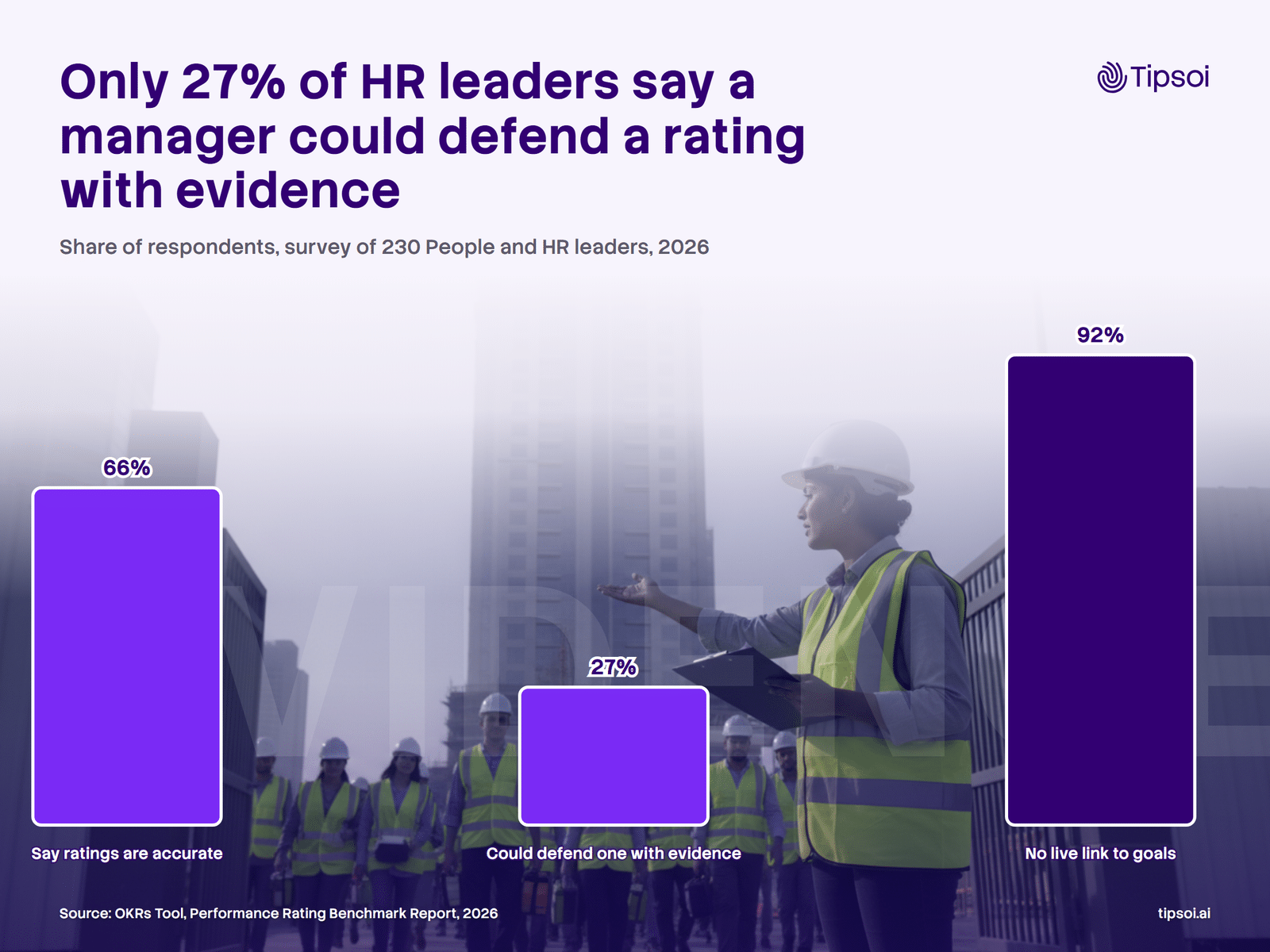
The numbers show how wide that gap is. In a 2026 survey of 230 People and HR leaders by OKRs Tool, 66% said their ratings are accurate. But only 27% said a manager could back up a rating with evidence. And 92% of firms run reviews on tools with no live link to their goals.
Staff feel it as well. A Gartner survey of nearly 3,500 employees in October 2024 found that 87% think algorithms could give fairer feedback than their managers. HR can answer that doubt by putting clear records on the table before any rating is written.
Attendance data in performance management systems
At Tipsoi, our part in performance management systems is the attendance record underneath the review. That way, the review your managers already run starts from facts. Here is how each report answers a question that comes up in almost every review.
| The review question | Where the proof comes from in Tipsoi |
|---|---|
| Who is reliable? | Absent Summary and Late Report: how often, and how many hours were lost. |
| Who works the hours the role needs? | Working Hour Report: expected versus actual hours, plus the average. |
| Which team is falling behind? | Department-wise attendance benchmarking. |
| Who is at risk of overwork? | Working Hour Report: staff who often work more than their scheduled hours. |
| What are field staff doing? | Field Visit Report: visits, time spent and approval status. |
| Who puts in extra effort? | Overtime Report: overtime worked next to overtime approved. |
| Where is all the proof kept? | Employee Profile: attendance, leave and employment history in one place. |
How it changes a review
Consider a site supervisor on AED 4,000 a month whose manager has marked him as unreliable. Before the review, HR opens the Late Report. It shows four late arrivals in six months, all in the same fortnight. The Working Hour Report also shows he averaged more than his scheduled hours. As a result, the question changes from “why are you always late?” to “what happened in those two weeks?” That is a far better place to start.
Still, numbers only open a conversation, and people explain them. For example, a run of late arrivals can point to a school run, a long commute or a health problem. HR is the team that has to ask. Used this way, attendance data protects good staff from unfair ratings as much as it flags real problems.
Overtime deserves a second look in the UAE. Under Federal Decree-Law No. 33 of 2021, normal working hours stop at 8 a day or 48 a week. Overtime should not go beyond two hours a day. Employers pay overtime at the normal wage plus at least 25%. Between 10 pm and 4 am the extra rises to 50%, although that night rate doesn’t apply to shift workers. So when overtime worked runs well ahead of overtime approved, you are seeing one of two things. Either someone is putting in real extra effort that deserves credit, or a workload problem is building towards burnout. Our time attendance software for UAE teams keeps both figures side by side.
UAE labour law
UAE labour law doesn’t require performance management systems or formal reviews. But it does set timings that decide when a review matters most. Probation can last up to six months, notice periods are fixed, and larger employers have Emiratisation targets. So if you build your review calendar around these rules, your records will be ready when you have to decide.
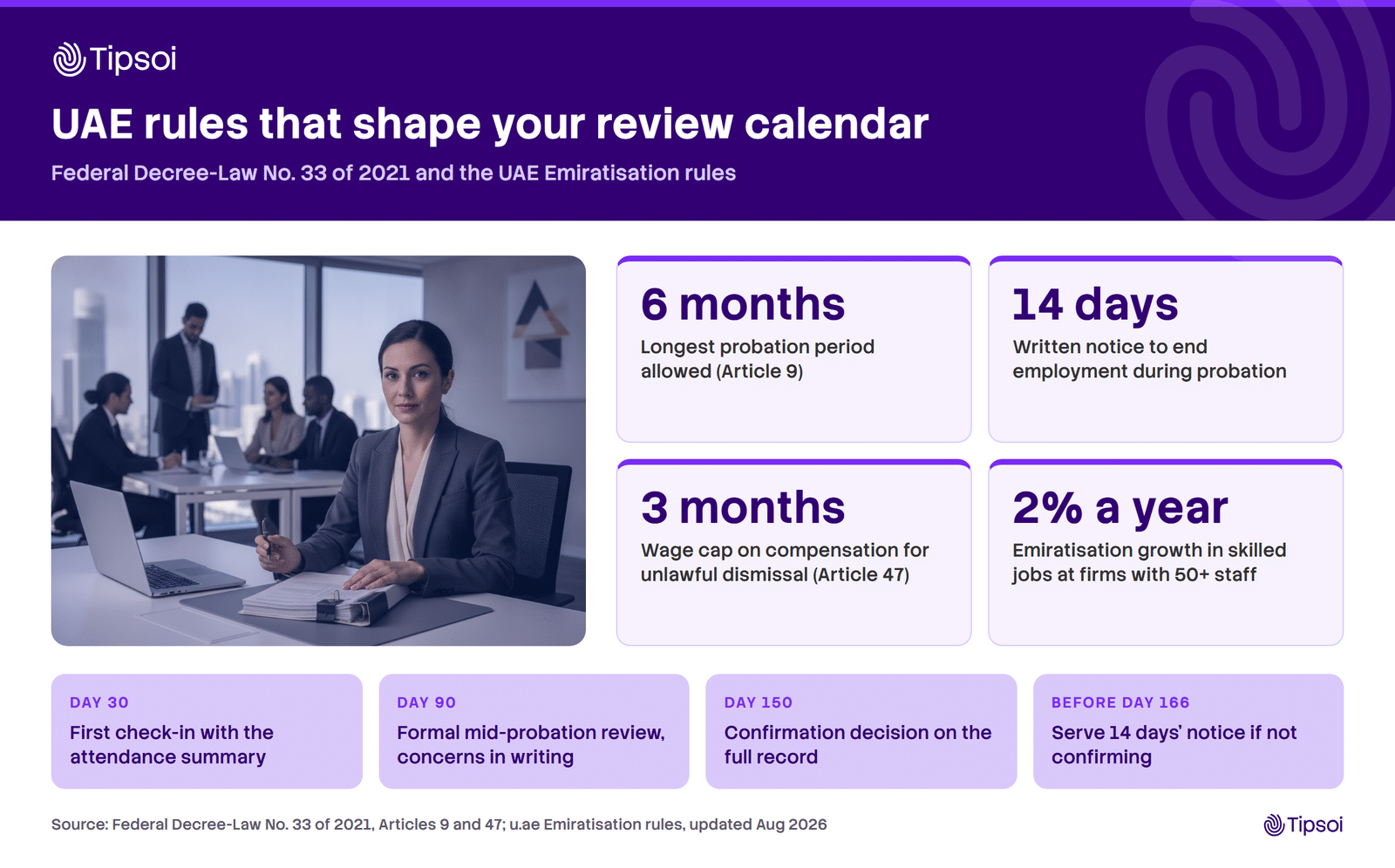
Article 9 of Federal Decree-Law No. 33 of 2021 allows a probation period of up to six months. An employer who ends employment during probation must tell the worker in writing at least 14 days before. The rule also works the other way. A worker who moves to another UAE employer during probation must give at least one month’s written notice. A foreign worker leaving the country must give 14 days.
A probation review calendar
Here is the calendar I suggest to managers. It works backwards from the six-month limit, so there is time to act on what the record shows.
- Week 1: write down the role’s goals and the attendance rules, then share them with the new hire.
- Day 30: hold a short check-in with the first month’s attendance summary on the table.
- Day 90: run the formal mid-probation review and note any concerns in writing.
- Day 150: decide whether to confirm, using the full record since day one.
- Before day 166: if you won’t confirm the new hire, serve the 14 days’ written notice so it ends within probation.
A common myth about dismissal
Many managers believe the law requires a formal improvement plan before anyone can be let go. It doesn’t. Article 47 of Federal Decree-Law No. 33 of 2021 sets a narrow rule. A dismissal is unlawful when it follows a serious complaint to MoHRE, or a lawsuit that proved valid. In those cases, compensation can’t exceed three months’ wages, based on the last wage paid. Even so, written reasons matter, because they show that a decision rested on performance and conduct. Good performance management systems give you exactly that: a dated record.
Emiratisation records
Emiratisation gives you another reason to keep good records. The UAE government portal sets the rule for private companies with 50 or more employees. They must raise Emiratis in skilled jobs by 2% a year, for an overall increase of 10% by 2026. Since 2023, firms that miss the target have paid AED 6,000 a month for each Emirati not hired. That amount rises by AED 1,000 each year until 2026. Performance management systems help here too, because they show how you train, review and promote Emirati staff. That record is useful when MOHRE asks about your numbers. It is even more useful for keeping the people you hired.
How to choose
Start with how your people work, then pick the review method, and only then compare performance management systems. A desk team on quarterly targets needs different tools from a construction crew on rotating shifts. So before any demo, list the questions your reviews must answer. Then check that each tool can show the evidence behind them.
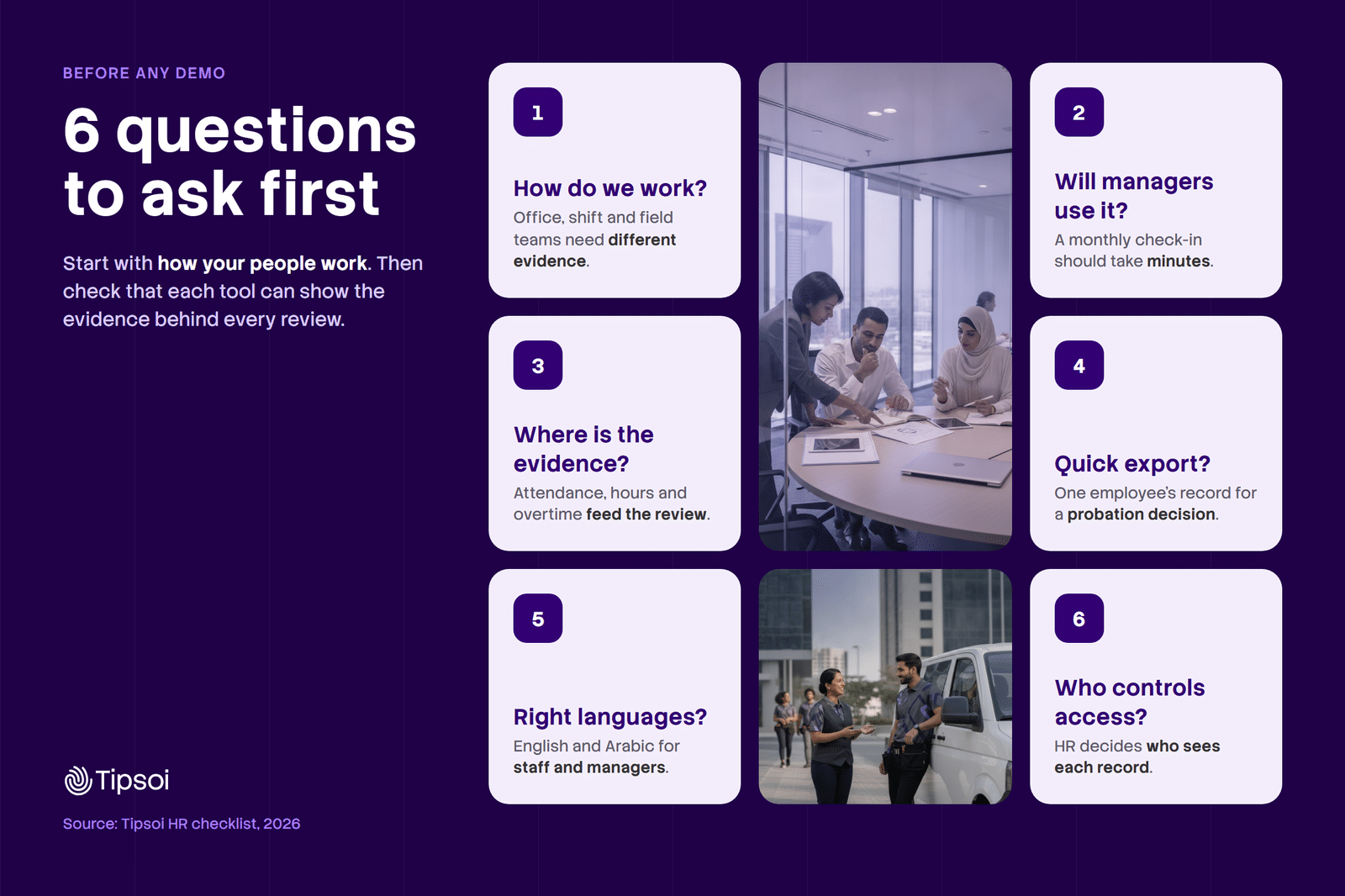
Questions I ask before a demo
- How do our teams work? Office, shift and field teams produce different evidence, so the tool has to fit the teams you really have.
- Will managers use it every month? If a check-in takes more than a few minutes, busy supervisors will skip it, and the record goes quiet.
- Where will the evidence come from? Ask how attendance, working hours, overtime and field visits reach the review, and whether anyone exports files by hand.
- Can we pull one employee’s full record? You’ll need it for a probation decision, a dispute or a MOHRE query, often at short notice.
- Does it work in our staff’s languages? For many UAE teams, that means English and Arabic for both managers and employees.
- Who controls access? Performance records are sensitive, so HR should decide who can see, edit and export each one.
If most of your workforce clocks in at a site or on the road, question three matters most when you compare performance management systems. To see how attendance, leave and payroll fit together, read our overview of HR software in the UAE. Our guide to workforce management in the UAE also covers shifts and field teams.
Common questions
What is PMS in the HR department?
PMS stands for performance management system. In an HR department, it covers setting goals, checking progress, reviewing work and rewarding results. It also covers the software that stores those records. So when people ask what the PMS says, they usually mean the record from the last review cycle.
What is an example of a performance management system?
A Dubai retailer might run quarterly check-ins for head office staff and an attendance-linked scorecard for store teams. Before each review, store managers read punctuality, absence and working hours beside their own notes. Then, once a year, managers compare ratings across stores so the same standard applies everywhere.
What are the 5 elements of a performance management system?
The five elements are planning, monitoring, developing, rating and rewarding. Planning sets goals, and monitoring tracks progress. Developing closes gaps through training or coaching. Rating sums up performance at set points, while rewarding links pay, promotion or praise to the results.
Are performance management systems required by UAE law?
No. UAE labour law doesn’t require a formal review process. But probation is limited to six months, and ending it needs 14 days’ written notice. Larger private employers also have Emiratisation targets. A written review record helps you handle all three with confidence.
How often should performance reviews happen?
Once a year is too slow on its own. In October 2024, Gallup reported that frequent feedback matters. People are far more likely to be engaged when their manager gives feedback a few times a week or more. So most HR teams pair one formal annual review with short monthly or quarterly check-ins. For new hires in the UAE, also add reviews at day 30, day 90 and day 150 of probation. That way, the decision to confirm never comes as a surprise.
Can performance management systems use attendance data?
Yes, as one input among several. Late arrivals, absences, working hours and overtime show reliability and workload in a way memory can’t. But always read the numbers in context, and let the person explain a pattern before it affects a rating.
Next steps
You don’t need to replace your performance management systems to make the next review fairer. Instead, start with three steps this month.
- Pick the review model that fits each team, using the table above.
- Put the probation calendar into each new hire’s first week.
- Pull six months of attendance, working-hour and overtime data for each person before their next review.
Are your managers still writing reviews from memory while the attendance record sits somewhere else? Then a short talk about connecting the two is a good place to start.