

Cloud HR software Singapore now accounts for the majority of new HRMS deployments, replacing on-premise systems that required local servers and IT maintenance. The shift makes practical sense: Singapore employers can access payroll, leave, and attendance data from any device, updates happen automatically, and most cloud vendors build CPF and MOM compliance rules into the platform from day one. We want to be direct about one thing: “cloud” does not automatically mean “compliant.” Some cloud HR software Singapore vendors host data outside Singapore, which creates PDPA complications. This guide covers what to evaluate, what the genuine risks are, and how to pick the right subscription.
Key Takeaways
Cloud HR eliminates on-premise maintenance: No local servers, no manual software updates, and automatic compliance rule updates when MOM or CPF Board changes rates (Source: general industry practice; verify with your vendor).
PDPA requires data localisation awareness: Singapore employers handling employee personal data must ensure cloud providers meet PDPA standards for data protection and cross-border transfer (Source: PDPC, https://www.pdpc.gov.sg/overview-of-pdpa/the-legislation/personal-data-protection-act).
CPF and MOM compliance must still be verified: Cloud delivery method has no bearing on whether the software correctly calculates CPF or enforces Employment Act leave rules. Verify these in your demo.
PSG covers cloud HR software subscriptions: Pre-approved cloud HR Software-as-a-Service (SaaS) vendors qualify under the Productivity Solutions Grant (Source: Enterprise Singapore, https://www.enterprisesg.gov.sg/financial-support/productivity-solutions-grant).
Mobile access is now standard: Most Singapore cloud HR platforms include iOS and Android apps for employee self-service, leave applications, and payslip access.
What Is Cloud HR Software?
Cloud HR software is an HRMS (Human Resource Management System) hosted on remote servers and delivered over the internet as a subscription service, rather than installed on local hardware. The employer accesses the platform through a web browser or mobile app. No local installation or IT server is needed.
The practical benefits for Singapore SMEs are real: the vendor handles uptime, security patches, and compliance rule updates. When CPF rates change (as they have multiple times in recent years), a good cloud HR software Singapore vendor pushes the updated rate tables to all customers automatically. With on-premise software, you wait for a patch release and install it manually.
One thing cloud delivery does not change: you still need to verify that the software actually calculates CPF correctly, enforces Employment Act leave rules, and supports IRAS AIS submission. Cloud is the delivery model. Compliance is the content. Both must be evaluated separately.
“Moving HR to the cloud is a good decision for most Singapore SMEs. The decision does not end there. Check where the data lives.”
What Are the Benefits of Cloud HR Software for Singapore Businesses?
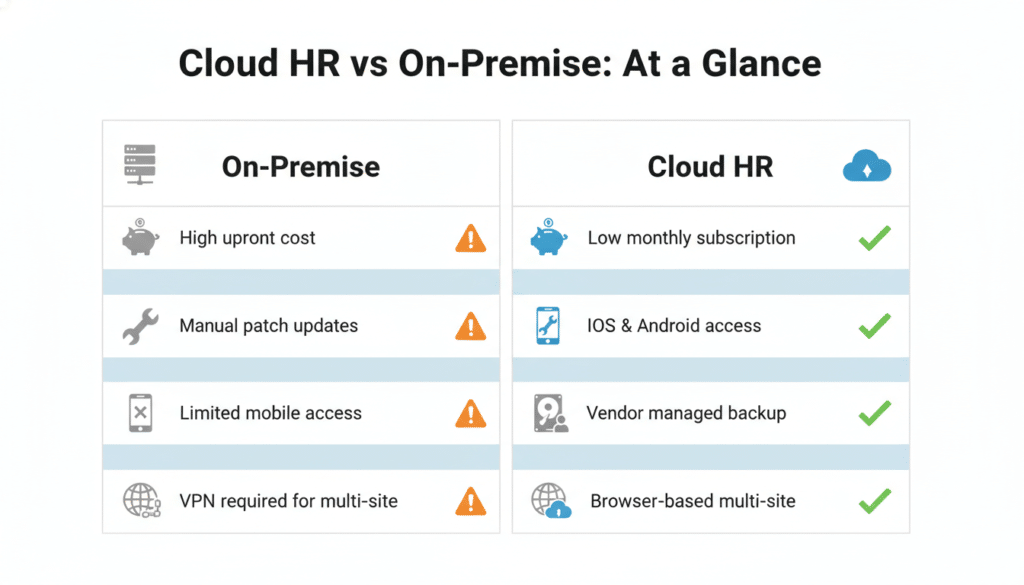
Cloud HR software gives Singapore businesses real-time access to payroll, leave, and attendance data from any device, with automatic compliance updates and lower upfront cost than on-premise systems.
| Feature | On-Premise HR | Cloud HR Software |
|—|—|—|
| Upfront cost | High (server + licenses) | Low (monthly subscription) |
| Compliance updates | Manual patch process | Automatic from vendor |
| Mobile access | Limited | Standard (iOS + Android) |
| Multi-site access | Requires VPN | Native, browser-based |
| Data location | Your premises | Vendor’s data centre |
| Backup responsibility | Your IT team | Vendor |
For Singapore SMEs without an IT department, the move to the cloud removes the server maintenance burden. For multi-location businesses (retail chains, F&B groups, construction firms), cloud-based employee attendance tracking in Singapore (https://tipsoi.ai/blog/employee-attendance-tracking-singapore) across sites becomes possible without a complex VPN setup.
What Should Singapore Employers Check for PDPA Compliance in Cloud HR?
Singapore’s Personal Data Protection Act (PDPA) requires employers to protect employee personal data and ensure any third-party processing of that data (including cloud HR vendors) meets equivalent protection standards (Source: PDPC, https://www.pdpc.gov.sg/overview-of-pdpa/the-legislation/personal-data-protection-act).
Ask every cloud HR software Singapore vendor these four questions before signing:
1. Where are your data centres located? (Singapore-based is safest for PDPA)
2. Do you have a Data Processing Agreement (DPA) for customers?
3. What encryption standard do you use for data at rest and in transit?
4. What is your breach notification procedure and SLA?
Vendors who cannot answer these clearly are not PDPA-ready. This is more important than feature comparisons.
What About Cross-Border Data Transfers?
If a vendor stores data on servers outside Singapore, the PDPA still applies to the transfer (Source: PDPC, https://www.pdpc.gov.sg/overview-of-pdpa/the-legislation/personal-data-protection-act). The vendor must meet a comparable protection standard. Ask for their cross-border transfer policy and evidence of comparable protection (such as ISO 27001 certification or data residency documentation).
How Does Cloud HR Software Handle CPF and MOM Compliance?
Cloud HR software handles CPF and MOM compliance the same way on-premise software does: by encoding the CPF Board’s rate tables and Employment Act rules into the calculation engine. The cloud delivery model means the vendor updates these tables centrally when rules change, so all customers get the updated rates simultaneously.
Specifically, confirm that your cloud HR software Singapore platform does the following:
– CPF auto-calculation by age bracket and wage ceiling using current CPF Board rates (Source: CPF Board, https://www.cpf.gov.sg/employer/employer-obligations/how-much-cpf-contributions-to-pay)
– IRAS AIS e-submission for IR8A annual filings
– MOM-compliant leave management with Employment Act statutory minimums
– Itemised payslip generation as required by MOM
If any of these are listed as “coming soon” or require manual configuration, the platform is not ready for Singapore payroll.
What Does Cloud HR Software Cost in Singapore?
Most Singapore cloud HR vendors list subscriptions in the SGD 3 to SGD 10 per employee per month range, based on publicly listed competitor pricing. Entry-level plans covering payroll and leave start at the lower end. Full-stack plans with biometric attendance integration, analytics, and multi-entity support run higher.
The PSG grant reduces subscription costs by up to 50% for eligible Singapore companies (Source: Enterprise Singapore, https://www.enterprisesg.gov.sg/financial-support/productivity-solutions-grant). The grant applies to qualifying SaaS subscriptions from the pre-approved vendor list. Check that your vendor is on the current PSG list before budgeting. For Tipsoi’s pricing, request a quote.
For companies evaluating HR software Singapore options broadly, the per-employee monthly cost of cloud software is typically lower than the total cost of ownership of on-premise systems when you account for server hardware, IT support, and manual compliance updates.
How Does Cloud HR Integrate with Biometric Attendance Hardware?
Most cloud HR software Singapore platforms integrate with biometric attendance devices via a cloud gateway, where the device sends timestamps to the cloud HRMS directly over the internet. This is more reliable than older USB-sync approaches that required someone to manually export and import attendance data.
When a biometric attendance system Singapore device connects to a cloud HRMS, attendance data appears in the HR dashboard in near real time. Managers can see who is on-site, and the payroll module uses the actual timestamps for overtime and shift calculations.
For HR payroll software Singapore platforms that are cloud-native, this integration is direct. For older cloud platforms that were converted from on-premise systems, the biometric integration may be a retrofit add-on. Test it with your actual device model before signing.
Frequently Asked Questions
Is cloud HR software safe for Singaporean employee data?
Cloud HR software is safe, provided the vendor meets Singapore PDPA standards for data protection, including encryption, access controls, and breach notification procedures (Source: PDPC, https://www.pdpc.gov.sg/overview-of-pdpa/the-legislation/personal-data-protection-act). Ask for the vendor’s Data Processing Agreement and confirm data centre location before signing. Vendors with Singapore-based data centres and ISO 27001 certification offer the strongest compliance posture.
Does cloud HR software update automatically when CPF rates change?
Yes, reputable cloud HR software Singapore vendors push CPF rate updates to all customers automatically when the CPF Board publishes new rates. This is one of the key advantages of cloud delivery over on-premise software. Confirm in your contract that the vendor commits to timely compliance updates as part of the service level agreement.
Can employees access payslips on mobile with cloud HR software?
Yes, most Singapore cloud HR platforms include employee self-service mobile apps where employees can view payslips, check leave balances, and submit leave applications from iOS and Android devices. This replaces emailed payslips, which are harder to secure and track. MOM’s itemised payslip requirement is met by the self-service portal record.
Is cloud HR software eligible for the PSG grant in Singapore?
Yes, several cloud HR SaaS vendors are pre-approved for the Productivity Solutions Grant (PSG), which covers up to 50% of qualifying subscription costs** (Source: Enterprise Singapore, https://www.enterprisesg.gov.sg/financial-support/productivity-solutions-grant). Eligible vendors include QuickHR, Carbonate HR, and Info-Tech Systems. Check the current pre-approved vendor list on the Enterprise Singapore portal, as the list is updated periodically.
What is the difference between cloud HR and on-premise HR software?
Cloud HR software is hosted by the vendor on remote servers and accessed via browser or app, while on-premise software is installed and run on the employer’s own servers. Cloud delivery reduces upfront cost and IT burden. On-premises gives the employer full control over data location and software configuration. For Singapore SMEs without IT staff, the cloud is the practical choice. For large enterprises with strict data sovereignty requirements, on-premise or private cloud may be preferred.
Conclusion
Cloud HR software is now the default choice for Singapore SMEs, and for good reasons: lower upfront cost, automatic compliance updates, mobile access, and no server maintenance. The risks are real but manageable. Check data residency, get a Data Processing Agreement, and confirm that the platform actually handles CPF and IRAS correctly before you sign. Cloud delivery does not guarantee Singapore compliance. It just makes delivering it easier for vendors who have done the work. We recommend treating PDPA compliance and CPF accuracy as non-negotiable filters, and everything else as a tie-breaker.
Tipsoi’s cloud HR software is built for Singapore compliance, with CPF auto-calculation, IRAS AIS support, and biometric attendance integration in one platform. Get a quote. Download Tipsoi’s HR Software Vendor Evaluation Scorecard to structure your comparison.