

Face recognition attendance system Singapore has moved from large enterprise deployments to everyday use across Singapore offices, factories, clinics, and construction sites. The cost has dropped, the accuracy has improved significantly, and the benefits over card-based and fingerprint systems are clear enough that most businesses evaluating attendance hardware are now asking “which face recognition system” rather than “whether to use face recognition at all.”
This guide covers what the technology actually does, what separates a good system from a poor one, how PDPA compliance works in practice, and what to look for when buying for a Singapore workplace specifically.
How Face Recognition Attendance Works
A face recognition attendance system captures an image of an employee’s face using an infrared or RGB camera on the device. The system runs the image through an AI algorithm that maps facial geometry, the distance between eyes, the shape of the jawline, the position of facial features, and converts it into an encrypted numerical template.
This template is compared against enrolled employee templates stored in the device or cloud database. If the match exceeds a confidence threshold, attendance is recorded, and the door opens (if access control is integrated). The entire process takes under one second on modern devices.
Three things make this different from a photo-based check:
Liveness detection: the device checks that it’s looking at a real face, not a printed photo or screen. Anti-spoofing algorithms detect 2D attacks (photos, videos) and flag them without allowing entry.
Template storage, not image storage: a compliant system stores the mathematical template derived from the face scan, not the actual photograph. The template cannot be reverse-engineered into a recognisable image. This is directly relevant to PDPA compliance.
Continuous learning: modern AI face recognition adapts to gradual changes in appearance (a new haircut, glasses, facial hair) without requiring re-enrollment, as long as the core facial geometry is consistent.
Why Singapore Businesses Are Switching to Face Recognition
Card Systems Are Easily Abused
Proximity cards and ID cards can be handed to a colleague. One employee can clock in for an entire team. In industries where overtime pay is significant, such as construction, manufacturing, and F&B, this costs real money. Face recognition removes this entirely. You cannot hand your face to someone else.
Fingerprint Limitations in Singapore’s Industries
Fingerprint readers work well in office environments. They struggle in Singapore’s construction and marine sectors, where workers handle rough materials, chemicals, and water that affect fingerprint legibility. Face recognition requires no physical contact and performs consistently regardless of what the employee’s hands look like at shift start.
Touchless Verification for Healthcare and Food Environments
Hospitals, clinics, food production facilities, and F&B outlets have hygiene requirements that make fingerprint readers problematic. A shared fingerprint surface touched by hundreds of employees daily is a contamination risk. Face recognition is fully touchless. Employees walk up, the device verifies, and they pass through. No surface contact required.
Speed at High-Traffic Entry Points
A well-configured face recognition terminal processes up to 20–30 employees per minute. During a shift changeover at a large manufacturing plant or construction site, where hundreds of workers arrive within a 10-minute window, this throughput matters. Fingerprint readers average 5–8 seconds per employee; face recognition averages under 1 second.
What to Look for When Buying a Face Recognition Attendance System in Singapore
1. AI-Powered Algorithm, Not Rule-Based
Older face recognition systems use rule-based matching; they compare faces against a fixed set of parameters. Newer AI-powered systems use deep learning models trained on millions of faces that improve accuracy and handle variable conditions better.
Ask vendors: Does the system use AI/deep learning, or is it rule-based? The difference matters for accuracy in variable lighting conditions, with masks, or with employees who have changed their appearance since enrollment.
2. Anti-Spoofing Capability
Any system without liveness detection can be fooled with a printed photo. In Singapore, where many businesses have valuable assets and restricted areas, this is not a theoretical risk.
Look for systems with binocular infrared cameras (which detect depth) or explicit anti-spoofing algorithms that flag 2D attacks. Ask for specifics: “anti-spoofing” on a spec sheet can mean very different things between vendors.
3. Indoor vs Outdoor Performance
Most face recognition terminals are designed for indoor, controlled lighting conditions. If you need to deploy at a construction site gate, outdoor warehouse entry, or car park barrier, you need a device rated for:
- Direct sunlight exposure (up to 100,000 lux outdoor light conditions)
- IP65 or higher weather resistance rating
- Wide temperature operating range (Singapore’s outdoor temperatures can hit 35°C+)
Not all devices meet these specifications. Confirm before purchasing.
4. Template Storage Capacity
Devices vary widely in how many enrolled face templates they can store locally. A small office system might store 1,000 templates. Enterprise-grade devices go to 50,000+. If you have a large workforce or plan to grow, check this specification before committing.
If the device relies entirely on cloud lookup rather than local storage, consider what happens when the internet connection drops. Local storage with cloud sync is more reliable than cloud-only.
5. Integration with Your HR and Payroll System
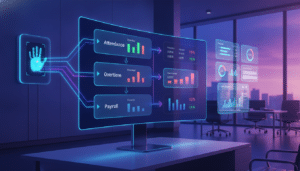
Face recognition hardware that doesn’t connect to your HR software creates a data island. You need a system where attendance records sync automatically to your HR platform, feeding leave management, overtime calculations, and payroll without manual re-entry.
In Singapore, where MOM compliance requires accurate working hour records, attendance data that sits separately from payroll creates reconciliation problems.
6. PDPA-Compliant Data Handling
Singapore’s Personal Data Protection Act applies to biometric data collection. A compliant face recognition attendance system must:
- Store encrypted templates, not raw facial images
- Allow employees to withdraw consent and have their data deleted
- Maintain security standards that protect against unauthorised access
- Have configurable data retention periods so templates are purged when employment ends
Ask vendors explicitly how biometric data is stored and whether templates or images are retained. The answer matters for PDPA compliance.
7. Local Support in Singapore
Face recognition devices are hardware. They will occasionally need firmware updates, maintenance, or replacement. A vendor with a local Singapore support team can respond to hardware problems within hours. A vendor relying on overseas support for a Singapore deployment means days of downtime when something goes wrong.
Face Recognition in Different Singapore Industries
Corporate Offices (CBD and Business Parks)
For office environments, a compact face recognition terminal at the main entrance serves attendance and access control simultaneously. Employees walk in, the device verifies, and the system logs their start time automatically. No clocking in at a separate terminal, no cards to tap.
For hybrid teams, pair the office terminal with mobile app attendance (GPS-verified), so remote workers can punch in from approved locations on the same system.
Construction and Civil Engineering
Singapore’s construction sector is one of the largest adopters of face recognition attendance because of the scale and complexity of managing large, multi-national workforces across active sites.
Outdoor-rated face recognition terminals at site gates record arrivals and departures for every worker. Combined with GPS tracking on the site manager’s app, project managers get real-time labour deployment data across multiple sites simultaneously.
Manufacturing and Logistics
Factories in Tuas, Jurong, and the various industrial estates managing shift-based workers use face recognition at production floor entries. Shift changeover records are automatic; no HR intervention is needed to confirm who worked which shift. Overtime is calculated from verified timestamps.
Healthcare
Hospitals and clinic networks use touchless face recognition at staff entrances and restricted areas. The same device handles both staff attendance and access control to medication storage or laboratory areas. Shift compliance documentation for licensing purposes is generated automatically from attendance logs.
F&B and Retail
Chain restaurants and retail outlets across Singapore use tablet-mounted face recognition apps for part-time staff attendance. The tablet sits at the back office entrance. Staff clock in with a face scan before starting their shift. Payroll for casual and part-time staff is calculated from verified timestamps, eliminating disputes over hours worked.
Tipsoi’s Face Recognition Attendance System in Singapore
Tipsoi offers AI-powered face recognition devices purpose-built for workforce management, not generic security cameras with basic recognition software.
What sets Tipsoi apart for Singapore deployments:
Tipsoi’s devices use deep learning-based face recognition with binocular infrared cameras for accurate liveness detection. Verification speed is under 0.5 seconds. The system handles variable lighting, identifies individuals with masks, and flags spoofing attempts without manual review.
Tipsoi is Singapore-headquartered at Bukit Batok Crescent. Implementation, onboarding, and support are handled by a local team, not routed through overseas call centres or resellers.
The platform integrates face recognition hardware with cloud attendance software, shift scheduling, leave management, and payroll automation in one system. Face scan data flows directly to payroll calculation. No separate software, no manual data transfer.
Tipsoi stores encrypted face templates, not images. Templates are purged automatically at employment end based on configurable retention policies. This design meets PDPA requirements for biometric data handling.
Devices are available for indoor office environments and outdoor site deployments. Our Singapore team recommends the right model after assessing your site conditions.
See Tipsoi’s full biometric attendance system for Singapore →
Face Recognition vs Fingerprint, Quick Comparison for Singapore Buyers
| Face Recognition | Fingerprint | |
| Contact required | None | Yes |
| Speed per employee | Under 1 second | 3–8 seconds |
| Works with dirty/wet hands | Yes | Limited |
| Works outdoors | Yes (with rated device) | Limited |
| Suitable for healthcare/F&B | Yes | Hygiene concerns |
| PDPA considerations | Template storage required | Template storage required |
| Cost | Higher | Lower |
For most Singapore businesses evaluating new attendance hardware in 2025, face recognition is the better long-term investment, especially in industries where fingerprint performance is limited and throughput at entry points matters.
Frequently Asked Questions
Is face recognition attendance legal in Singapore?
Yes, provided it complies with the Personal Data Protection Act. Employees must be informed that biometric data is being collected and for what purpose. Systems must store encrypted templates rather than raw images. Data must be secured against unauthorised access and deleted when no longer needed.
How accurate are face recognition attendance systems?
Modern AI-powered systems achieve recognition accuracy above 99% under standard conditions. Accuracy is affected by extreme lighting variations, significant appearance changes since enrollment, and low-quality cameras. Enterprise-grade devices with infrared cameras perform reliably in a wide range of conditions.
Can face recognition work with face masks?
Yes. Current AI-based systems are trained to recognise individuals with masks covering the lower face. Accuracy with masks is lower than without, but modern systems handle it reliably enough for workplace use.
What happens if the system can’t recognise an employee?
A well-configured system provides a fallback option, PIN entry, card tap, or a manual override that HR can approve. The attendance record is flagged for review rather than simply blocking the employee.
How long does employee enrollment take?
Enrolling one employee takes 30–60 seconds; they stand in front of the device, capture a few angles, and the template is saved. For large workforces, Tipsoi’s bulk enrollment process can register 500 employees in 2–3 hours.
Does the system work across multiple locations?
Yes. A cloud-based system like Tipsoi manages face recognition terminals across multiple Singapore sites from one admin account. Templates sync across devices, so an employee enrolled at one site can clock in at any other site.