


TL;DR
- Under the Employment Act, an employee gets 7 days of paid annual leave after their first year, rising by one day each year to a maximum of 14 days from year eight.
- Statutory leave only covers Part IV employees: workmen earning up to S$4,500 and non-workmen up to S$2,600 a month. Managers and executives get leave through their contract, not the law.
- You must have worked at least 3 months to earn leave, and part-years are pro-rated.
- Unused statutory leave can be carried forward for up to 12 months; after that it can be forfeited.
- When someone leaves, unused leave is usually paid out at their gross daily rate.
- New (July 2026): outsourced Progressive Wage Model workers will get a minimum of 10 days, up from 7, phased from 2029.
Work out entitlement, pro-rated days for a new joiner, and the pay-out value of unused leave. Nothing is stored.
How each number is worked out
How much annual leave do you get in Singapore?
If you are covered by the Employment Act and have worked for your employer for at least three months, you are entitled to paid annual leave. It starts at seven days in your first year and goes up by one day for every extra year of service, capped at 14 days once you reach eight years. Annual leave is only one of the statutory leave types under the Act. Sick leave, maternity and paternity leave, no-pay leave and public holidays each run on their own rules.
Here is the full ladder, straight from the Ministry of Manpower.
| Year of service | Days of paid annual leave |
|---|---|
| 1st year | 7 |
| 2nd year | 8 |
| 3rd year | 9 |
| 4th year | 10 |
| 5th year | 11 |
| 6th year | 12 |
| 7th year | 13 |
| 8th year and beyond | 14 |
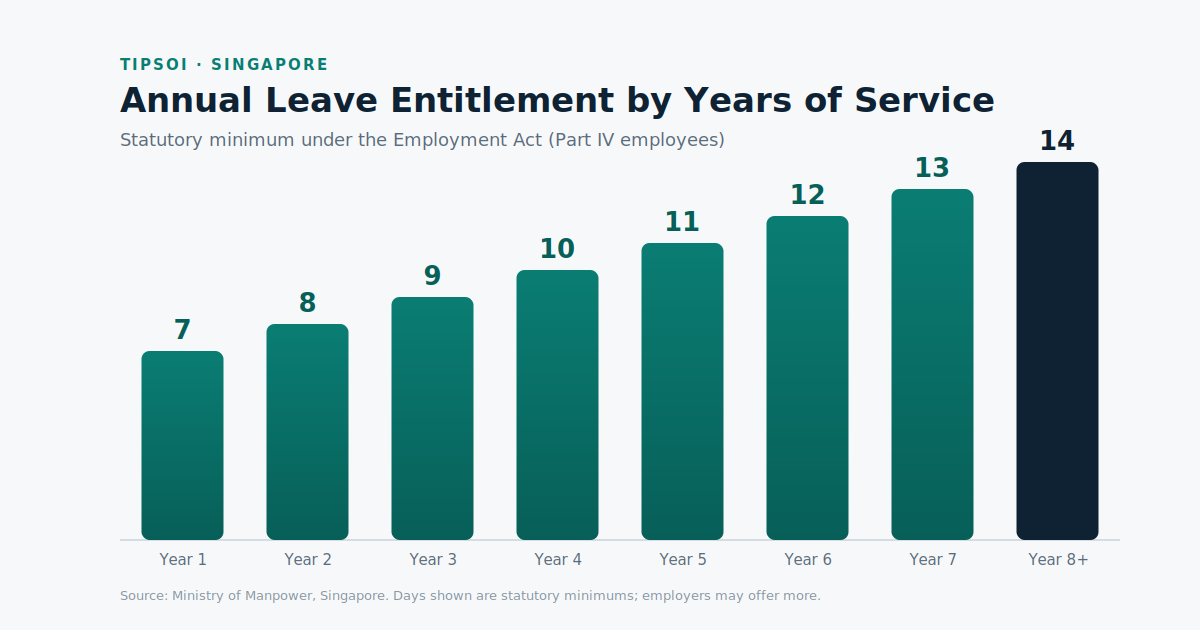
So 14 days is the statutory maximum. If you have seen 21 days advertised, that is an employer being generous, not the law; many companies offer more than the minimum to attract staff, especially for senior roles. Nothing stops them from doing so.
The part most employers get wrong: who the law actually covers
This is where I see handbooks go wrong most often. People assume the 7-to-14-day scale applies to everyone. It does not.
The statutory annual leave entitlement sits under Part IV of the Employment Act, and Part IV only covers two groups: workmen earning a basic salary of up to S$4,500 a month, and non-workmen (rank-and-file employees who are not managers or executives) earning up to S$2,600 a month.
If someone earns above those thresholds, or is a manager or executive, their annual leave is whatever their employment contract says. The law sets no minimum for them. Most employers still give these staff 14 days or more, but that is a business decision, not a legal floor. Writing “as per the Employment Act” in a PME’s contract without stating a number is the kind of vague wording that causes disputes later.
New in 2026: more leave for outsourced workers from 2029
On 19 July 2026, Minister of State for Manpower Dinesh Vasu Dash announced that outsourced workers under the Progressive Wage Model will get a minimum of 10 days of annual leave, up from seven. It applies to the outsourced cleaning, security, landscape, lift and escalator maintenance, and waste management sectors, and will be rolled out progressively from 2029, with the detailed schedule to be worked out with tripartite partners.
Part of the reason is a real gap I see often: when a service contract changes hands, workers with years of service can be moved to a new employer and restart at seven days as if they were new joiners. The higher floor is meant to protect long-serving lower-wage staff from that reset. If you run outsourced contracts in these sectors, this is worth planning for now, not in 2029.
Pro-rating leave for new joiners
Almost nobody starts on 1 January, so you will pro-rate constantly. The formula MOM uses is simple:
(Completed months of service ÷ 12) × annual leave entitlement
Round the result: if the fraction of a day is less than half, round down; if it is half or more, round up.
A worked example. Someone joins in April and has completed nine months by year end, on a first-year entitlement of seven days:
(9 ÷ 12) × 7 = 5.25 → rounds down to 5 days.
The calculator above does this for you, but it is worth knowing the maths so you can explain a payslip when someone questions it.
Carrying leave forward, and when it can be forfeited
“Can my company just cancel my unused leave?” is one of the most common questions people ask, and the answer has limits. For Part IV employees, unused statutory leave can be carried forward for up to 12 months. If it is still untouched after that window, it can be forfeited. Statutory leave can also be forfeited if an employee is dismissed for misconduct, or is absent without permission for more than 20% of their working days in the relevant period.
For managers, executives and higher earners, carry-forward and forfeiture are governed entirely by the contract. If your policy caps carry-over at, say, seven days and forfeits the rest, that is allowed for these staff, as long as it is written down and communicated. The problem is when the written policy and the enforced policy drift apart. I have reviewed handbooks where the stated carry-over rule would have been unlawful if enforced against a Part IV employee, and neither side realised until it became a dispute.
What happens to unused leave when someone leaves
When employment ends, unused annual leave is normally paid out. The value is the number of unused days multiplied by the employee’s gross rate of pay per day, which MOM defines as:
(12 × monthly gross rate of pay) ÷ (52 × number of days worked per week)
So for someone on S$3,900 a month working five days a week:
(12 × 3,900) ÷ (52 × 5) = S$180 per day.
Six unused days would be paid out as S$1,080. The same daily rate is what MOM uses for salary in lieu of notice and for paid leave, so it is worth getting the number right once and reusing it.
Annual leave for part-time employees
Part-timers earn leave too, pro-rated by the hours they work. MOM expresses it in hours, not days:
(Part-timer’s annual hours ÷ comparable full-timer’s annual hours) × full-timer’s leave days × full-timer’s daily hours
MOM’s own example: a part-timer on 20 hours a week, compared to a full-timer on 44 hours a week with a 7-day first-year entitlement:
[(20 × 52) ÷ (44 × 52)] × 7 × 8 = 25.5 hours of leave.
Expressing it in hours matters, because part-time shifts are rarely a neat eight hours, and converting to “days” hides the real balance.
Why letting leave pile up is a false economy
There is a temptation, on both sides, to treat unused leave as a bonus that gets paid out later. The research points the other way. A 2023 meta-analysis of vacation studies in European Psychologist found that taking leave produces real, measurable improvements in well-being, but that the benefit fades within weeks of returning to work. The practical lesson for an HR manager is that regular, well-spaced leave keeps people healthier and more productive than one hoarded block at year end, and that a workforce sitting on large untaken balances is usually a sign of a scheduling problem, not a saving.
Common mistakes I see
- Applying the 7-to-14-day scale to managers and PMEs as if the law required it.
- Forgetting the three-month qualifying period before leave accrues.
- Pro-rating without rounding the way MOM specifies, so payslips do not reconcile.
- A carry-forward policy in the handbook that does not match what payroll actually enforces.
- Tracking leave in a spreadsheet across multiple entities, then losing the audit trail when someone queries a balance.
That last one is why we built leave tracking into Tipsoi’s HR platform: entitlement, pro-ration and carry-over rules applied automatically, with a record you can actually show an employee.
Frequently asked questions
How many days of annual leave do you get in Singapore? Seven days after your first year of service, increasing by one day each year to a maximum of 14 days from your eighth year, if you are covered by Part IV of the Employment Act.
How do I calculate my annual leave in Singapore? Take your entitlement for the year and, if you have not completed a full year, pro-rate it: (completed months of service ÷ 12) × entitlement, rounded to the nearest day. Use the calculator above to do it instantly.
Is annual leave mandatory in Singapore? Yes, for Part IV employees (workmen up to S$4,500 and non-workmen up to S$2,600 a month). For managers, executives and higher earners it is set by the employment contract, not the law.
Is 14 days the maximum annual leave, and what about 21 days? 14 days is the statutory maximum under the Employment Act. Any figure above that, such as 21 days, is an employer offering more than the law requires, which is allowed and fairly common for senior staff.
Can my employer forfeit my unused annual leave? Statutory leave carries forward for up to 12 months and can only be forfeited after that, or if you are dismissed for misconduct or absent without permission for more than 20% of your working days. For non-Part IV staff, the contract decides.
Is unused annual leave paid out when I resign? Usually yes. Unused leave is paid at your gross rate of pay per day, calculated as (12 × monthly gross salary) ÷ (52 × days worked per week).
How does annual leave work for part-time staff? It is pro-rated by the hours you work against a comparable full-timer, and expressed in hours rather than days.
How much annual leave will outsourced workers get from 2029? Outsourced Progressive Wage Model workers in cleaning, security, landscape, lift and escalator maintenance and waste management will get a minimum of 10 days, up from seven, phased in from 2029.
Do I get annual leave in my first three months? You start earning leave once you have completed three months of service; leave for that first partial year is pro-rated.
Sources
- MOM, Annual leave — eligibility and entitlement: https://www.mom.gov.sg/employment-practices/leave/annual-leave/eligibility-and-entitlement
- MOM, Annual leave — special situations: https://www.mom.gov.sg/employment-practices/leave/annual-leave/special-situations
- MOM, Leave for part-time employees: https://www.mom.gov.sg/employment-practices/part-time-employment/leave
- MOM, Monthly and daily salary (gross rate of pay): https://www.mom.gov.sg/employment-practices/salary/monthly-and-daily-salary
- NTUC, Outsourced PWM workers to get minimum 10 days of leave from 2029 (19 Jul 2026): https://www.ntuc.org.sg/pubeu/news/Outsourced-Progressive-Wage-Model-workers-to-get-minimum-10-days-of-leave-from-2029/
- de Bloom et al., vacation & well-being meta-analysis, European Psychologist (2023): https://econtent.hogrefe.com/doi/10.1027/1016-9040/a000518