
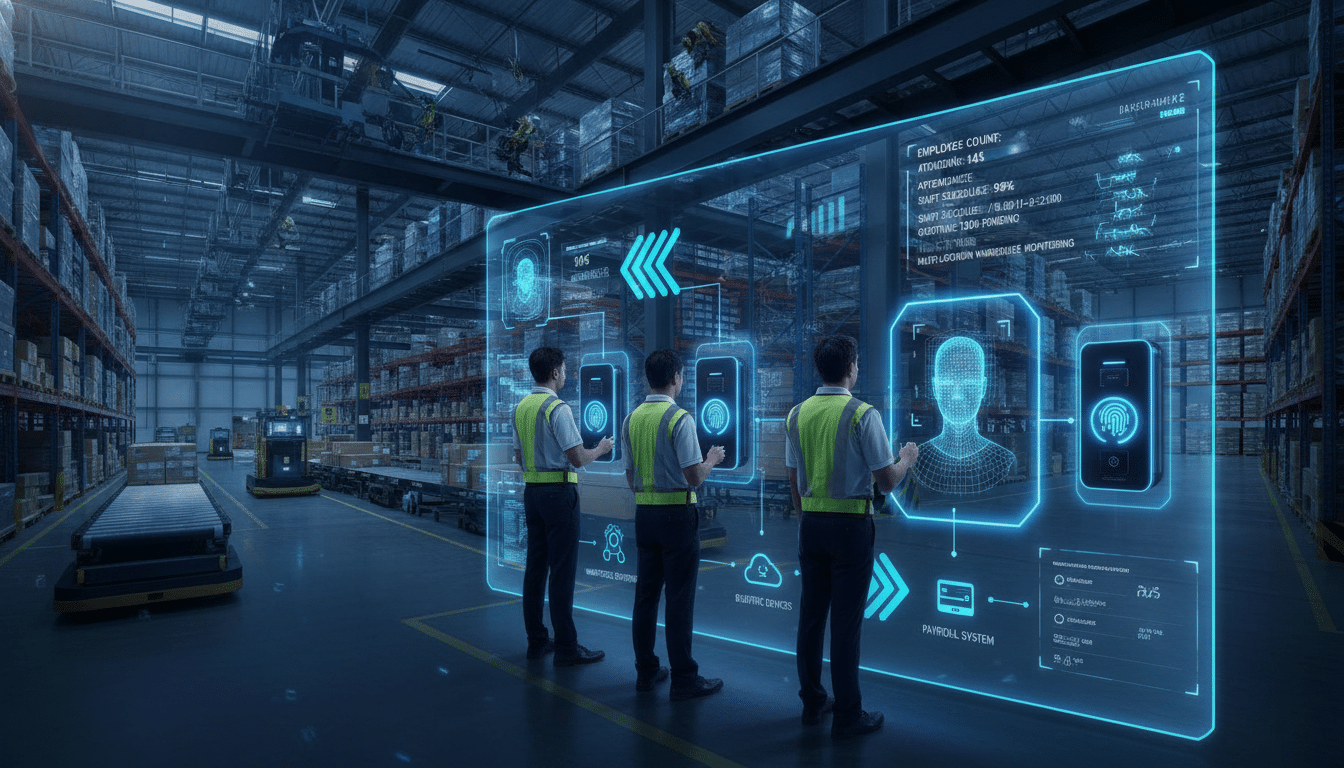
Logistics and warehouse operations in Singapore run on shift precision. A loading dock team that starts 15 minutes late delays an entire outbound shipment. A security guard who leaves early before the replacement arrives creates a liability gap. Manual attendance in 24-hour warehouse operations does not work because there is no HR staff present at 3 am to verify sign-in sheets. Biometric attendance solves the verification problem at every shift, at every hour, without requiring administrative oversight at the time of the clock-in.
Key Takeaways
- 24-hour operations require offline-capable devices: Singapore logistics warehouses often have unreliable internet at loading bays. Devices must buffer attendance records locally and sync when connectivity is restored.
- Glove use in warehouse environments means face recognition is often better than fingerprint: Pickers, packers, and forklift operators frequently work in gloves. Face recognition removes the need to remove gloves at each clock-in.
- Shift handover accuracy is an operational requirement, not just a compliance requirement: In logistics, the incoming shift cannot start work until the outgoing shift is confirmed out. Biometric timestamps make this verifiable.
- Foreign worker attendance records are mandatory for MOM compliance: Logistics employers with Work Permit holders must maintain daily attendance records (Source: MOM).
- Multiple entry and exit points require multiple devices: A warehouse with three entrances needs three devices, all reporting to the same cloud HR account.
Operational Challenges in Logistics Attendance
Logistics and warehouse environments in Singapore create four attendance management problems that office HR systems are not designed to handle.
The four problems:
- Round-the-clock shifts: A payroll system that closes at 6pm cannot process clock-ins at 2am without automation.
- High headcount at shift changes: 50 workers arriving simultaneously at a shift start creates queues at a single biometric device. Plan for throughput.
- Variable locations: Drivers and delivery staff clock in at the warehouse but work at client sites throughout the day. GPS mobile check-in may be needed as a complement to device-based attendance.
- Physical environment: Loading bays are dusty, have variable lighting, and may be exposed to outdoor air. Devices need appropriate ratings.
Device Selection for Warehouse Environments
The right biometric device for a Singapore logistics warehouse depends on the specific work area. Loading bay and outdoor storage areas need weatherproof-rated devices. Air-conditioned picking and packing areas can use standard office-rated devices.
Device selection by area:
| Area | Environment | Recommended Device |
|---|---|---|
| Loading bay (outdoor/semi-covered) | Dust, humidity, variable light | IP65 face recognition |
| Air-conditioned warehouse | Controlled environment | Capacitive fingerprint or face recognition |
| Security checkpoint | High throughput | Face recognition, fast-match mode |
| Driver dispatch area | Mixed, variable | Multi-modal fingerprint + card |
| Cold storage area | Below 10°C | Check device operating temperature rating |
For cold storage areas, verify the device’s minimum operating temperature. Most standard biometric devices are rated to 0°C. Sub-zero environments require cold-rated devices.
Managing 24-Hour Shift Operations
A biometric attendance system in a 24-hour warehouse must operate without HR oversight at off-peak hours. This means the device handles everything: recording the clock-in, buffering if connectivity drops, and syncing when the connection is restored.
For the cloud HR platform to reflect accurate attendance across all shifts:
- Configure all three shifts (morning, afternoon, night) in the HR platform before go-live
- Set the shift boundary times so the platform assigns each clock-in to the correct shift
- Configure late arrival and early departure alerts to notify the duty manager in real time
- Test a clock-in at 2 am before going live to confirm overnight sync works
Our team has seen Singapore warehouses deploy biometric systems without configuring the night shift in the HR platform. The device records all clock-ins correctly, but the platform assigns night shift arrivals to the wrong shift because the boundary is not defined. Fix this in setup, not after payroll disputes start.
“A biometric device is only as accurate as the shift rules configured in the HR platform behind it.”
Foreign Worker Attendance Compliance
Logistics companies in Singapore employ significant numbers of Work Permit holders. MOM requires employers to maintain attendance records for these workers, particularly for overtime and rest day work verification (Source: MOM).
A cloud-connected biometric system produces MOM-compliant records automatically:
- Daily clock-in and clock-out timestamps linked to the worker’s Work Permit number
- Overtime hours calculated against the contractual threshold
- Rest day work flagged for the additional MOM-mandated payment rate
- Records are retained for the required 2-year period without manual filing
For employee attendance tracking in Singapore’s logistics, the foreign worker compliance requirement is often the primary driver for upgrading from manual records.
Frequently Asked Questions
How many employees can a single biometric device handle at a warehouse shift change?
High-speed face recognition terminals can process 20 to 30 check-ins per minute. For a 50-person shift change, this takes 2 to 3 minutes with one device. For 100-person shifts, install two devices side by side at the same entry point to halve queue time.
Do Singapore warehouse biometric devices work in low-light conditions?
Face recognition terminals using infrared cameras work in low-light and near-dark conditions. Visible light cameras degrade in poor lighting. Verify the device uses infrared imaging before purchasing for areas with variable or low lighting.
Can biometric attendance integrate with Singapore warehouse management systems (WMS)?
Biometric attendance integrates with the HR platform, not directly with the WMS. Attendance data flows to the HR platform for payroll. If your WMS requires staff presence data, check whether your HR platform has an API that your WMS vendor can connect to.
How do Singapore logistics companies handle attendance for drivers who are away from the warehouse all day?
Combine warehouse-based biometric clock-in with GPS mobile check-in for off-site work. Drivers clock in at the warehouse device at the start of their shift. They use a mobile HR app with GPS location tagging for mid-day check-ins at client sites. Both records appear in the same HR platform attendance report.
What is the correct way to record overtime for Singapore warehouse workers under MOM rules?
Overtime is hours worked beyond the contractual daily or weekly hours, paid at 1.5 times the hourly rate up to the MOM overtime cap of 72 hours per month (Source: MOM). The biometric attendance system records the hours; the HR platform calculates the overtime rate automatically if shift rules are configured correctly.
Conclusion
Logistics and warehouse attendance in Singapore requires 24-hour device operation, offline buffering, appropriate environmental ratings, and shift rule configuration that matches operational reality. Manual attendance cannot scale to 24-hour operations with high headcounts at each shift change. Biometric systems can be used when correctly specified for the environment. Select the device for the work area, configure the shifts before go-live, and automate the foreign worker record-keeping.
Tipsoi’s cloud attendance system supports 24-hour shift configuration, multi-gate deployment, and automatic MOM-compliant record retention for Singapore logistics operations. Get a quote. Download Tipsoi’s Warehouse Attendance Configuration Guide for a shift setup checklist.