

Heads of security keep asking the same question. Who controls the lock when the power cuts out? Four parts share that job: the reader, the controller, the power supply, and the lock. The reader checks the face or card. The controller makes the access decision. The power supply feeds the lock. The electromagnetic lock holds the door shut. Tipsoi builds the reader. That is just one of those four jobs. The rest comes from your controller, power and lock suppliers.
Key takeaways
- An electromagnetic lock holds with power alone. So, cut the power, and it releases at once, no matter what the reader just decided.
- The reader’s Wiegand output carries a decision. But it does not carry lock power. So a reader-compatible controller is not a lock-compatible circuit.
- Most exit doors need a fail-safe lock, so nobody is trapped in a fire.
- Tipsoi supplies the reader and platform, not the lock or the fire-alarm link.
- Test every release case before rollout, including a true loss of power.
How Does the Lock Work?
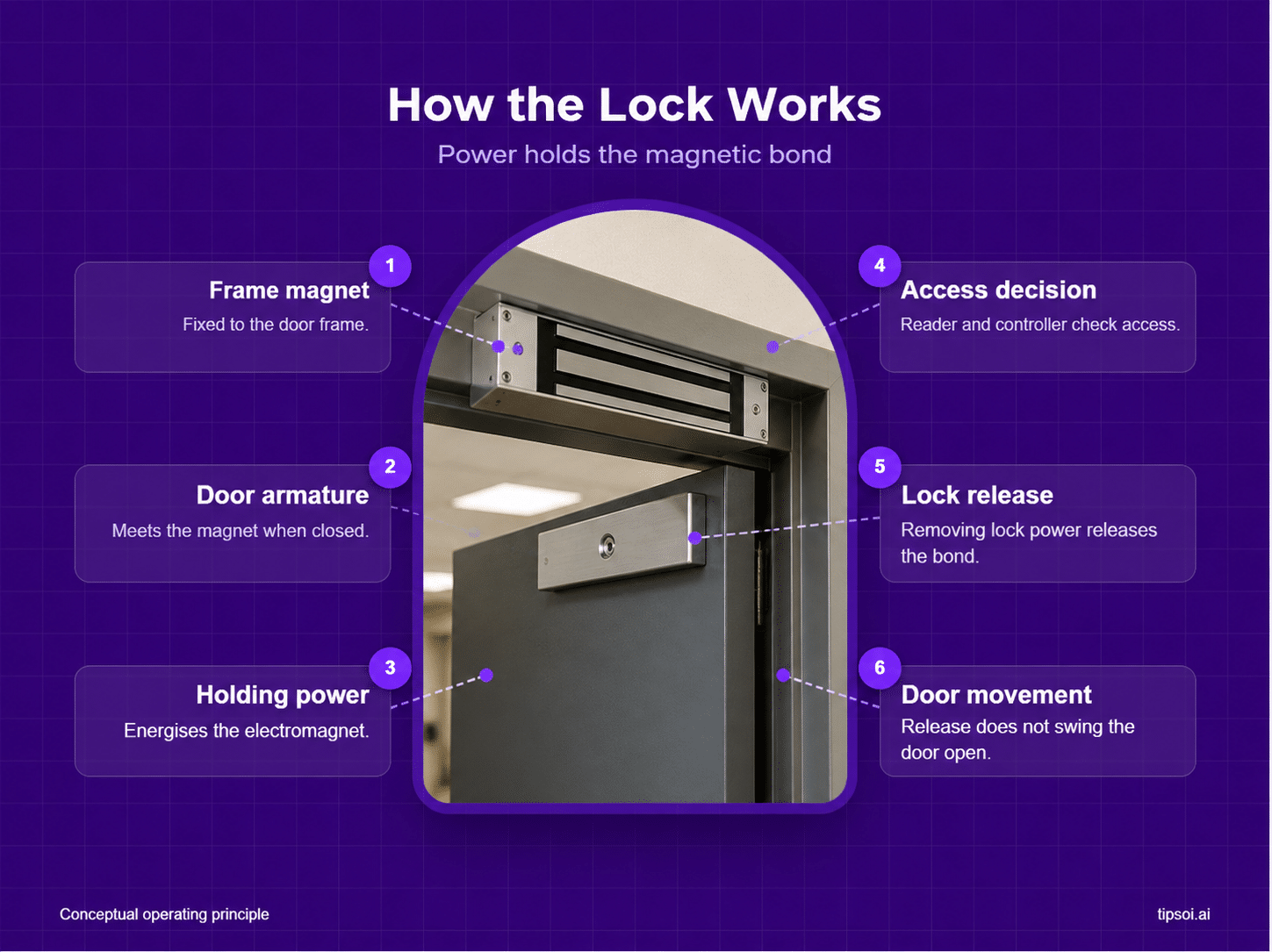
A magnet on the frame and a plate on the door hold tight while current flows. Cut that current, and the bond lets go at once.
Four roles sit here. The reader decides. The controller flips a switch, called a relay. The power supply feeds the lock. Mix up any two, and the fire review stalls.
This matters because the electromagnetic lock itself never checks who wants to leave. It only checks one thing: is power still on. So that is what makes fail-safe release work. But a weak power supply can also drop the door open on a short power blip, not just a real outage.
So, check three numbers on any spec sheet first. First, the holding force, in kilograms or pounds. Then the running voltage and current draw. Also, whether it has a built-in door-status sensor. One common mix-up: buyers think a locked electromagnetic lock has a manual override, like a padlock key. But it does not. The only way to open it without a credential, meaning a face, card or code the reader accepts, is to cut its power. So the fire-alarm link matters as much as the electromagnetic lock itself.
How Does the Reader Connect?
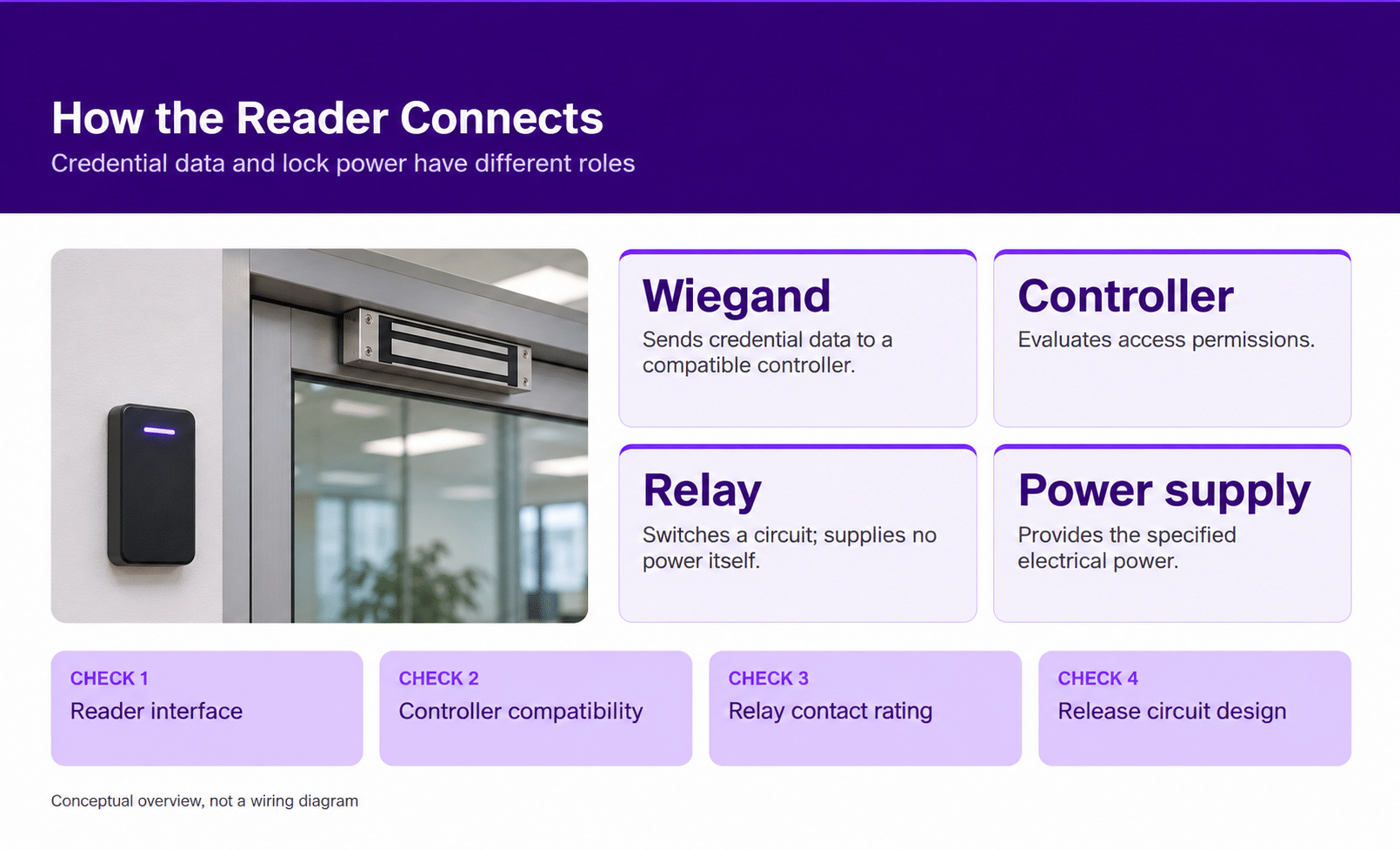
A reader and a lock run on their own wires. The reader sends its decision to the controller over Wiegand, an old signal format. The Wiegand effect was patented in the 1970s, and it’s still the default on most Malaysian sites in 2026. The electromagnetic lock, though, draws its own power.
Tipsoi’s FastFace 8 FTC has a relay and a Wiegand output. But it has no door-lock support. So check the controller’s format first. Then check the electromagnetic lock’s own power draw too. Do both before you buy.
Ask your installer three things before you sign off on a controller.
- Check it reads this reader’s exact Wiegand bit length. Not just “Wiegand” as a generic label.
- Check the relay’s dry-contact rating, in amps, against the lock’s start-up current.
- Check the power supply has its own fuse, and a battery sized for the electromagnetic lock, apart from the reader.
A controller can read the credential fine. But it can still drive an undersized relay. That one mismatch is the most common reason a rollout stalls, often after the reader is already mounted.
How Should Emergency Release Work?
A fail-safe electromagnetic lock releases the moment power is lost. A fail-secure electromagnetic lock stays shut through it. Every Malaysian rollout in 2026 still has to choose one. Most exit doors need fail-safe, so nobody gets trapped in a fire.
Malaysia’s building by-laws require escape routes to stay accessible and clear for quick evacuation (Uniform Building By-Laws 1984, Part VII fire-safety requirements). Check the exact clause with your fire officer or Bomba.
This isn’t one setting for the whole building. Take a main exit, a stairwell door, or any door on an escape route. So that door is almost always fail-safe. The law puts the right to leave above the need to keep someone out during a fire. Still, take a door off the escape route, such as a server room or a vault lobby with a second exit. That door can stay fail-secure. But only if the site’s fire consultant agrees, because security still matters there and the occupant has another way out.
So, before you sign off, run four tests, not one.
- Normal exit, without a credential.
- The named emergency-release device.
- The fire-alarm panel’s own trigger, reaching that specific door.
- A true loss of lock power, with the backup battery removed.
A door that passes the first three tests but fails the fourth has a wiring fault, not a design fault. So it will still fail a real fire-safety audit.
What Must You Check Beforehand?
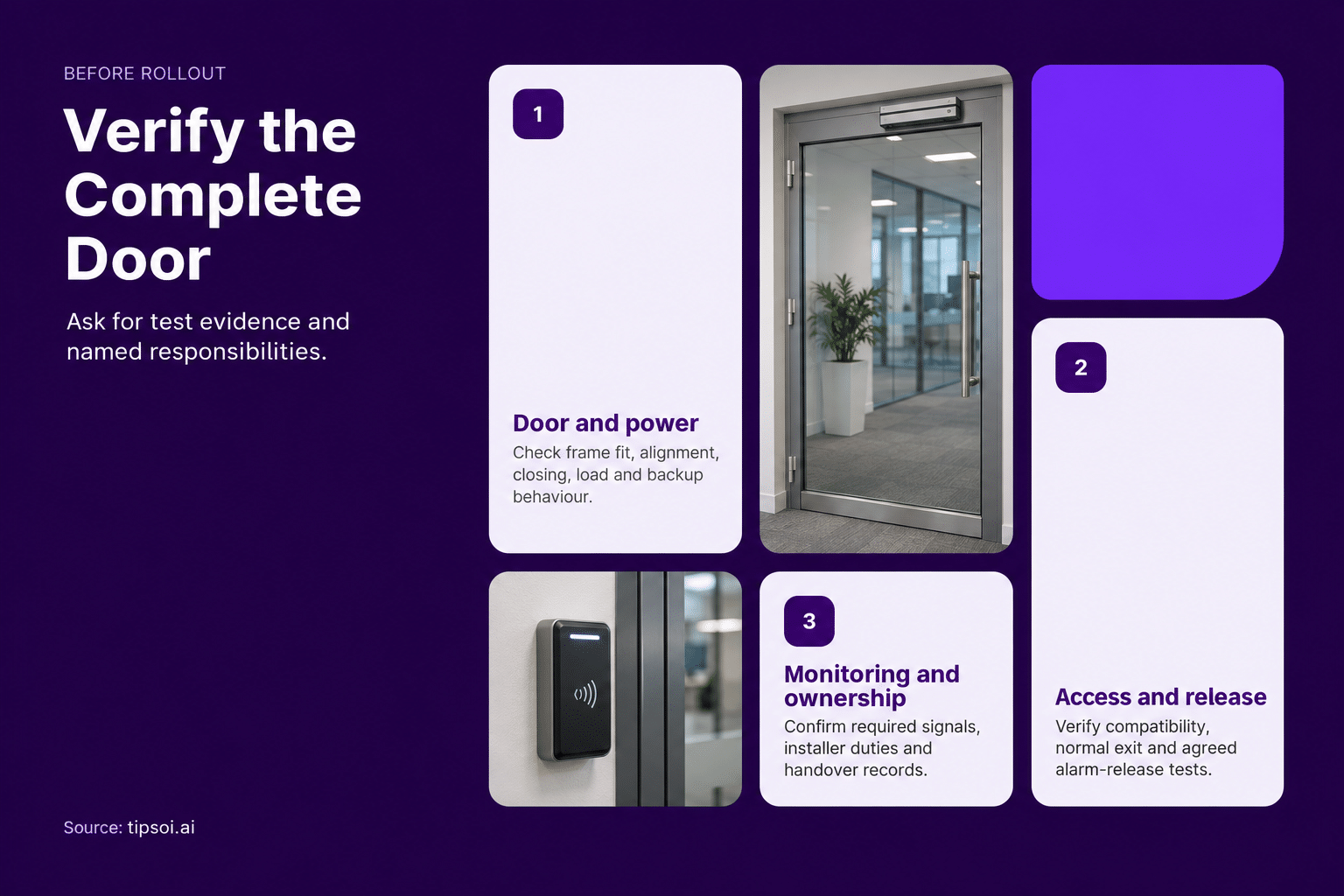
So, run this list as a sign-off sheet, not a memory check. Also, name one person for each row, before you even order the lock. Then nobody has to recall a detail on test day.
| Check | Confirm |
|---|---|
| Door and frame | Fits the lock’s bracket and force rating |
| Power design | Sized for the lock, with backup |
| Interfaces | Reader and lock circuits both match |
| Exit | A request-to-exit device needs no credential |
| Alarm link | Fire panel reaches the release circuit, tested live |
| Fault case | The lock releases on its own power loss |
| Monitoring | Door sensor reports open, closed, forced |
| Ownership | One named party per lock and alarm link |
Budget in Malaysian Ringgit (RM) for the whole rollout, not just the reader. That budget covers the electromagnetic lock, its power supply, the controller, and the fire test.
Tipsoi’s own terminals, sold across Malaysia in 2026, carry CE marking under EU Directive 2014/35/EU.
They also meet the FCC’s Part 15 rules. Every unit shipped in 2026 is tested against those same rules.
FastFace 8 carries an IP65 rating under IEC 60529, last amended in 2013. None of these three marks cover the lock.
Where Does Tipsoi Fit?
Tipsoi supplies the reader and the platform, not the electromagnetic lock, the power supply, or the fire-alarm link. So, name that split up front, before you place the order. It keeps your go-live date on track. Also, it stops the fire-safety review from stalling on a question nobody owns.
BRAC Bank reached 843 devices across 647 locations with Tipsoi, as of November 2026. The reader and the lock stayed apart the whole time.
Inovace Technologies Limited is ISO 9001:2015 and ISO/IEC 27001:2022 certified. But none of that proves fire-code compliance. That still comes from the installed system, not a certificate.
In practice, a buyer still sources three things apart from the reader.
- The electromagnetic lock, with its own power supply and backup battery.
- A controller checked to match the reader’s Wiegand output and the electromagnetic lock’s relay rating.
- A fire-alarm interface, wired and tested by the building’s own fire contractor.
So Tipsoi’s part of the project ends at the reader, and the platform that records who it recognised, and when.
Also see our guide on duplicate access cards and our piece on RMiT and PDPA.
Frequently Asked Questions
What happens during a power failure?
A fail-safe electromagnetic lock releases at once. But a fail-secure electromagnetic lock stays shut. That suits a cabinet, never an exit.
Will any reader fit any lock?
Not automatically. First, the reader’s signal, Wiegand or OSDP, has to match what the controller reads. Also, the controller’s relay rating has to match what the electromagnetic lock draws at start-up. So match one and miss the other, and the install still stalls.
Does Tipsoi’s reader back up the lock’s power?
No. The lock needs its own power supply, sized for its holding current. Also, it needs its own backup battery, apart from whatever powers the reader.
How do you test the release before rollout?
Run four tests, and keep a record. Normal exit, without a credential. The named emergency-release device. The fire-alarm panel actually triggering that door. And a true loss of lock power, with the backup battery disconnected.
Who answers for a failed fire-alarm test?
Whoever installed that lock and its alarm link. Name one owner for each, before handover.
Before You Approve the Rollout
Pilot one or two doors for a week. That finds a mismatch, or a bad sensor, that one demo never will. So close every open issue first. Then sign off, with all four release tests on record.
Start at Tipsoi’s Malaysia access-control hub, and bring your lock and alarm contractors in early.