


Most company milestones are gradual. Occasionally, a handful of days does the work of a year.
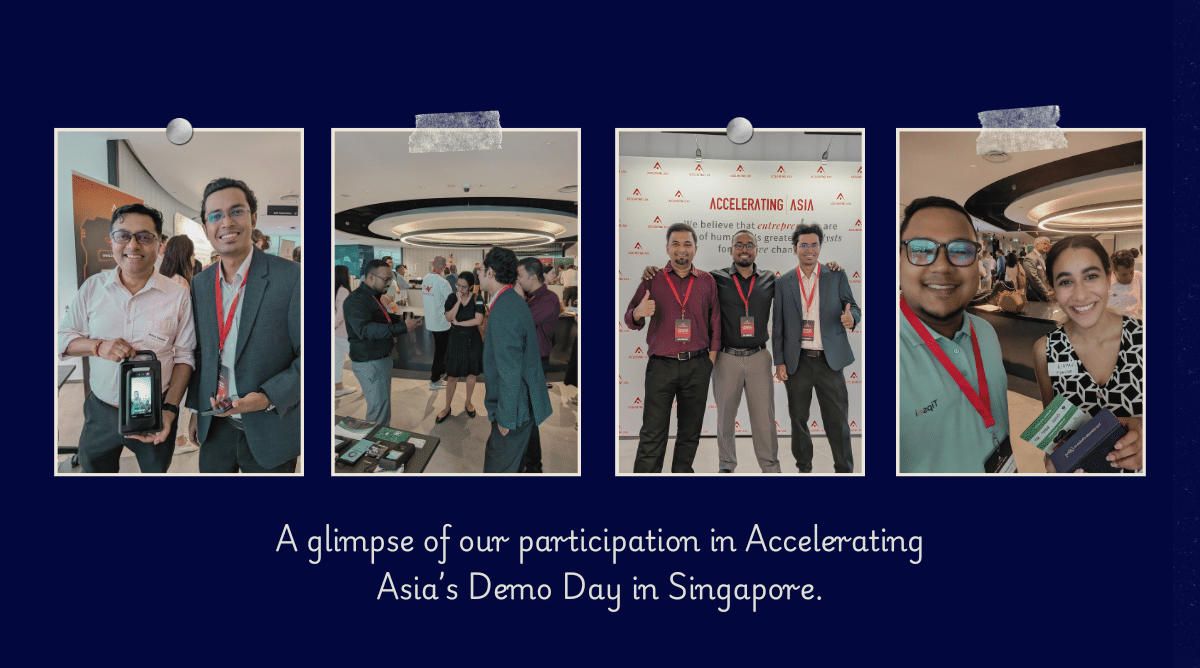
For Inovace Technologies Ltd., Accelerating Asia Demo Day in Singapore was one of those compressed moments. A Bangladeshi startup built to fix a workforce problem that shows up in almost every organisation walked onto a regional stage, told its story, and left with a very different set of conversations underway.
A Stage That Does Not Open Often
Accelerating Asia had already put its confidence behind our mission, and the Demo Day invitation turned that backing into access. In one room sat investors, operators, and mentors who spend their working lives assessing which early companies in Asia are worth betting on.
That access is worth something precisely because outcomes are rarely guaranteed. Accelerating Asia’s own data shows that fewer than 15% of Demo Day participants walk away with immediate investor interest. The accelerator treats two signals as the real proof of a pitch that landed: an investor calendar that fills inside 48 hours, and partnership conversations that begin without prompting. Tipsoi hit both.
The Team That Made the Trip
Four people flew to Singapore: CEO Md. Munirul Alam, Managing Director Asif Aminur Rashid, CTO Ikram Shimul, and Growth Lead Kazi Fahmid Hassan Rafi.
The brief was simple to state and harder to execute. Explain what Tipsoi does. Represent Bangladesh well. And find people who understand why this work matters, not only at home but across every emerging market where the same problems repeat.
Kazi Fahmid Hassan Rafi, Assistant Manager for Growth at Inovace Technologies Ltd., was central to how the pitch came together. He helped shape the pitch strategy and carried the company’s expansion vision into conversations with international investors.
“It has been an overwhelming experience, one that boosted our confidence and gave real validation to what we’re building. Demo Day wasn’t just a presentation; it was a glimpse of the global scale of our mission. We’re walking away more energized than ever to take Tipsoi into new markets and make real change.” Kazi Fahmid Hassan Rafi, Assistant Manager for Growth, Inovace Technologies Ltd.
Three Days of Preparation Before a Single Slide
Demo Day itself lasted hours. The preparation took three full days, run alongside mentors including Craig Bristol Dixon, Osman Ahmed, Amra Naidoo, and Kiren Tanna, founder of Foodpanda. Their job was to pressure-test the narrative: what to cut, what to lead with, how to make the numbers land.
Amra Naidoo made a point during those sessions that reframed how the team presented its origins.
“Bangladeshi startups have unique advantages in solving workforce challenges because they understand resource constraints and scalability requirements that larger markets often overlook. Tipsoi’s approach demonstrates how emerging market solutions can lead global innovation.”
The Pitch: Absenteeism as a Line Item
Asif Aminur Rashid took the stage and introduced Tipsoi as what it is, a product aimed at a problem most organisations tolerate rather than solve: attendance and absenteeism.
Absenteeism is a universal cost. Companies worldwide lose more than $2.8 billion a year to it. It rarely appears as a single dramatic expense, which is exactly why it survives so long inside payroll, scheduling, and productivity numbers without anyone naming it.
The presentation covered the traction already built, the data behind the value Tipsoi delivers, and the scale of the market still waiting. Above all, it described a version of workforce management that is smarter, more human, and better fitted to the people using it.
Tipsoi’s results in Bangladesh matter here for a specific reason: they demonstrate that the model scales into other emerging markets facing comparable workforce conditions. The Singapore Demo Day extended that logic across South and Southeast Asia, with investors recognising how well the solution maps onto countries dealing with similar economic and operational pressures.
How the Room Responded
The reaction was immediate. Curiosity first, then genuine interest, then a queue of people wanting more detail. Several investors said plainly that they had not seen a solution like this emerge from the region, one with proven use cases, sound economics, and an obvious route to scale.
There is a pattern behind that reception. Studies consistently show that Asian investors are three times more likely to engage with workforce management solutions that can prove clear ROI and regional scalability. Tipsoi’s framing of attendance and absenteeism worked because it spoke to a $2.8 billion gap across emerging economies rather than a niche software preference.
Since the event, the calendar has looked entirely different. Follow-ups, investor calls, and partnership discussions have filled it, and the pace has not slowed.
The Numbers Behind the Reception
Post-event tracking gives a clearer picture than any anecdote:
- A 400% increase in investor inquiries
- Meetings scheduled across five countries
- Investor meetings secured with 12 or more potential partners
- Partnership discussions with companies representing over $50 million in combined revenue
- A 300% increase in partnership inquiries after the event
- Market demand validated across three Southeast Asian countries
- Positioned for Series A closure by August 2025
Measured against Accelerating Asia’s historical data, that performance places Tipsoi in the top 10% of Demo Day participants and establishes it as the leading workforce management solution in emerging markets.
Why the Model Resonated
The advantage Tipsoi demonstrated was a combination rather than a single feature: a working understanding of how workforces actually behave in emerging markets, paired with technology architecture that scales.
Western workforce management platforms often assume a level of infrastructure and implementation resource that many organisations simply do not have. Tipsoi is built to operate inside existing constraints while still producing measurable ROI. For investors evaluating deployment risk across multiple markets, that combination was the compelling part.
Where This Goes Next
The immediate focus is converting Demo Day conversations into working relationships and strategic partnerships, with the current round targeted to close by August. The capital has a purpose attached: taking Tipsoi into more countries where workforce absenteeism remains a daily operational drag.
The next phase applies the same proven methodology to India, Indonesia, Vietnam, and the Philippines, markets that together account for more than two billion workers dealing with comparable attendance and engagement problems. Research consistently indicates that early entry into these regions creates durable competitive advantage for workforce technology companies.
What This Means for Organisations Watching
Demo Day was a company milestone, but the underlying problem belongs to employers, not startups. Any organisation running shift-based teams, multiple sites, field crews, or a mix of all three recognises the symptoms: attendance data that arrives late, payroll corrections that keep repeating, and no reliable live view of who is actually on site.
That is the gap Tipsoi was built to close, whether through AI-powered biometric attendance devices at entry points or a cloud platform that turns attendance records into usable workforce data. For sectors where the workforce moves between locations daily, such as construction and site-based operations, the reporting problem tends to be sharpest and the improvement most visible.
If your teams face similar attendance and engagement challenges, the same methodology that drew investor attention in Singapore is the one available to your operations.
About Accelerating Asia
Accelerating Asia is a Singapore-based VC accelerator backing high-growth, high-impact startups across South and Southeast Asia. Its programming is founder-first, with a strong emphasis on investor readiness and hands-on mentorship, and it works with companies like Tipsoi to unlock global potential.
The Wider Pattern: Innovation Under Constraint
Tipsoi’s reception reflects something broader than one pitch. Startups in emerging markets are increasingly solving universal business problems through locally grounded innovation, and research indicates that workforce management solutions developed under resource constraints frequently outperform traditional enterprise software on efficiency, cost-effectiveness, and user adoption.
This is what is usually called reverse innovation. Products designed to work within tight constraints eventually move upward, serving developed markets with solutions that are simply better built for real conditions. It is the position companies like Tipsoi are moving into. You can read more about the company behind Tipsoi and how the platform developed.
Frequently Asked Questions
What sets Accelerating Asia’s Demo Day apart from other startup events?
Accelerating Asia concentrates specifically on high-growth, high-impact startups across South and Southeast Asia. Participants get three days of intensive mentorship with industry leaders, direct access to tier-1 investors, and a founder-first structure. Portfolio companies have collectively raised over $200 million.
What global impact did Tipsoi actually demonstrate in Singapore?
Three things: immediate investor interest originating from five different countries, partnership discussions spanning three emerging markets, and validation that the workforce management solution applies across diverse economic regions beyond Bangladesh.
Who is Amra Naidoo?
Amra Naidoo is an experienced startup mentor and investor advisor focused on helping Asian startups scale globally. Her work covers pitch refinement, investor readiness, and market expansion strategy for B2B SaaS companies.
How long does funding usually take to close after a strong Demo Day?
Accelerating Asia’s data shows that successful participants generally close their rounds within three to six months. Tipsoi’s August 2025 target sits within the faster end of that range, which strong Demo Day performances tend to support.
Why does Bangladesh matter in the global workforce management market?
Bangladesh combines rapid economic growth, varied workforce challenges, and real pressure to optimise resources, which makes it a demanding proving ground. Solutions that work there tend to show unusually strong scalability potential in other emerging markets.