 4.9/5
4.9/5
Tipsoi records every shift and calculates payroll from the same data. Your team can clock in by face, fingerprint, RFID card or phone. We make our own terminals, including a portable one for site work. Billing is in AED, and support comes from Dubai.






3.5 hrs on manual data entry
12 mistakes found in attendance sheet
Paper sheets and shared cards cost you twice. First in the hours your HR team spends rebuilding them. Then again in the payroll fixes and WPS mismatches that follow.
3.5 hrs on manual data entry
12 mistakes found in attendance sheet
Nine things UAE teams use every day, in one platform. Tap a card for the detail.
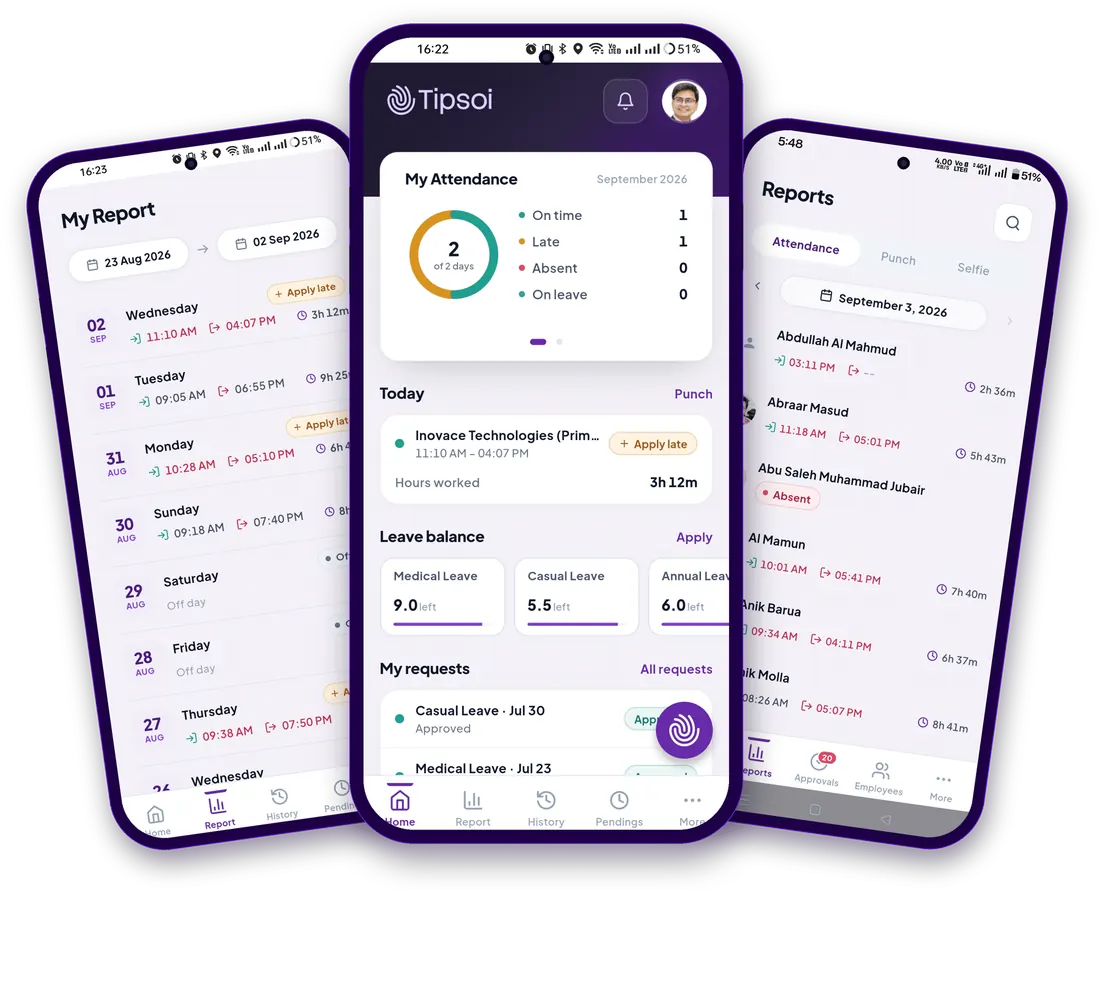
Staff punch at the gate or in the app, then see their own hours, overtime and leave balance. Supervisors approve on the same screen, which saves your HR team a great deal of chasing.


| Capability | Tipsoi | greytHR |
|---|---|---|
| Own attendance hardware (face, fingerprint, RFID) | ||
| Syncs with third-party devices you already own | Partial | |
| AED billing with local Dubai invoicing | ||
| Recruitment / ATS module | ||
| Depth of the full payroll suite | ||
| On-device face template capacity | 20,000 |
Where greytHR is stronger, it says so. We do not sell a recruitment module.
Three numbers our UAE customers report. Each one is measured against the manual process it replaced.
Saved each month, once no one has to rebuild timesheets by hand (Tipsoi UAE, 2026).
Saved each year, once manual attendance and payroll rework stop (Tipsoi UAE, 2026).
Face match accuracy on our own terminals, in 0.2 seconds or less (Fastface 3 Pro, 2026).
The questions UAE teams ask us before they switch. WPS deadlines, overtime bands, sites in more than one emirate, and what a rollout needs from you.
Send us your headcount, site list and the terminal models you already own. We answer against your setup, in AED, from Dubai.
A time and attendance system records when each employee starts and finishes work, then turns those timestamps into the hours, overtime and absence figures your payroll runs on. In the UAE that usually means three parts: a clock-in method, cloud software that holds the rules, and an export into payroll. The clock-in method is a face or fingerprint terminal, an RFID card, or a phone app with a GPS boundary. The software applies your shift patterns, grace periods and public holidays. Tipsoi terminals match a face in 0.2 seconds or less at 99.99% accuracy and hold 20,000 face templates on the device, so attendance keeps working when the internet does not, and it holds 100,000 attendance logs on board (Fastface 3 Pro, 2026).
Most Dubai shortlists mix three kinds of supplier: hardware importers who resell terminals, HR suites that treat attendance as a side feature, and platforms that do both. Ask four questions. Does payroll come out of the same records as the timesheet, or a separate upload? Is the price in AED with a local invoice? Who answers at 9am Gulf time? And will it read the devices you already own? On the third and fourth, an importer often wins on price and loses on payroll; on the first, an HR suite often wins on payroll and cannot supply a terminal. We publish where greytHR beats us for the same reason.
Attendance data is personal data, and biometric templates are the most sensitive kind, so treat storage and access as a procurement question rather than an IT detail. Tipsoi stores a mathematical template, not a photograph of a face, which means the record cannot be turned back into an image if it ever leaked. Access is role-based: a site supervisor sees their own team, HR sees the whole tenant, and every change to a record leaves an audit entry with the user and timestamp attached. That audit trail is what settles a dispute months later, and it is the part manual sheets can never produce. Ask any vendor two questions before you sign: what exactly is stored per employee, and can you export or delete one person’s record on request.
A single-site setup is usually live inside a week; a multi-site or free-zone group takes two to four, and almost all of that time is yours rather than ours. What we need up front is an employee list, your shift patterns and grace periods, the public-holiday policy you actually apply, your approval chain for leave and overtime, and the model numbers of any terminals you already own. The technical work is mounting terminals and pointing them at the tenant. The work that decides whether the project succeeds is agreeing the shift rules before go-live, because a rule fixed in week one is a configuration change and the same rule fixed in month three is a payroll correction. We run the first payroll cycle alongside your existing process so the two can be compared before you switch off the old one.
Cost has three parts: the platform per employee, the terminals, and the modules you switch on. What moves the number most is headcount and how many doors need a reader, not the software itself. The saving to weigh it against is measurable: Tipsoi customers in the UAE report 10 or more HR hours back every month and AED 18,000 or more off yearly admin cost, against roughly 20% higher team productivity (Tipsoi UAE, 2026). Billing is in AED with a local invoice, so there is no foreign-currency spread on top. Send us your headcount and site list and we will quote against it rather than publish a number that fits nobody.
Three, in practice. The daily exception list is the one HR opens every morning: who is late, who is absent without notice, who clocked in outside their assigned site. The monthly overtime and premium report is the one finance argues over, because it shows the cost of night hours, rest-day work and public holidays split into the bands the law defines rather than as one lump. The Overtime Report is the one that prevents a bad month: it shows overtime worked next to overtime approved, so only verified hours reach payroll. Everything else in the reporting suite is useful; those three are the ones that change behaviour.
Book a 30 minute meeting with the Tipsoi team. We use your headcount, sites and shift pattern, so you see your own numbers.
We fit the terminals, or connect the ones you own. Then we enrol staff and set up shifts, overtime bands and the UAE holiday calendar.
One cycle runs on both systems. When the payroll totals match, you switch. A single office is usually live inside a week.

Staff clock in with a face scan, fingerprint, RFID card or the phone app. The cloud software applies your shift rules, grace periods and the UAE public-holiday calendar, then sends hours, overtime and absence into payroll. Nothing is re-keyed, so the timesheet and the salary always agree.
Price depends on three things: how many employees are on the platform, how many terminals you need and where they sit, and which modules you switch on such as payroll automation, shift planning or live location. Billing is in AED with a local invoice. Send us your headcount and site list and we will quote against it rather than guess.
Tipsoi calculates each salary from the same attendance records that produced the timesheet. You then pay through your approved bank or exchange house under the Wage Protection System.
In most cases yes. Tipsoi integrates with most security, access-control and time-attendance devices on the market, and with the ERP, HRM or payroll system you already run. Send the model numbers and we will confirm before you buy anything.
Yes. Shift patterns, night hours, rest days and public holidays are applied automatically and split into the right premium bands under UAE Federal Decree-Law 33 of 2021, with the cost visible before payroll closes.
All seven, with support based in Dubai and billing in AED. Multi-site and free-zone setups run as separate payroll entities inside one tenant.